
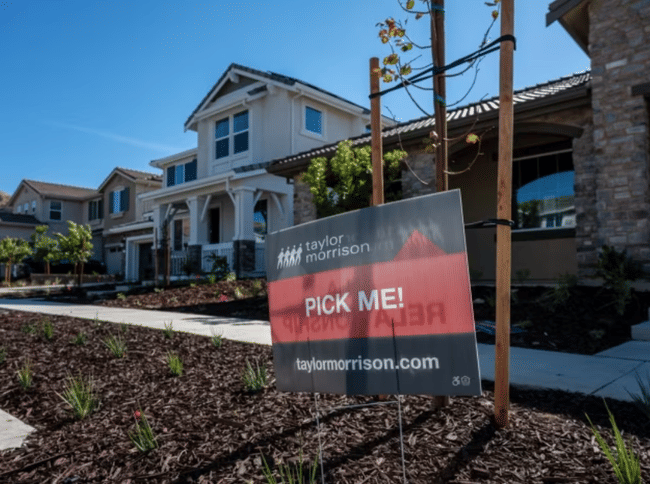
Berkshire Hathaway is acquiring Taylor Morrison Home Corporation for $8.5 billion in cash - a 24% premium to last Friday's close. It's Greg Abel's first major deal since taking over from Warren Buffett in January 2026, and it sends a clear message: Berkshire believes the U.S. housing market is due for a comeback. Taylor Morrison will go private and eventually merge with Clayton Homes into a unified homebuilding platform.
Abel taps cash reserve for the first time
$BRK-B Hathaway closed the first quarter of 2026 with a record $397 billion in cash and short-term investments. The acquisition of $TMHC by Taylor Morrison for a total enterprise value of $8.5 billion, with $6.8 billion in equity, marks the first multibillion-dollar transaction since Abel took over from Warren Buffett in early 2026.
The logic of expanding the housing platform
In the housing segment, Berkshire already owns prefabricated homebuilder Clayton Homes, a number of building materials manufacturers and real estate franchise Berkshire Hathaway HomeServices. A key signal is Abel's intention to consolidate conventional homebuilding into one common platform. Analyst Christopher Davis of Hudson Value Partners called it a "significant change" from Berkshire's traditional strategy of letting acquisitions operate completely independently. Berkshire already owns Clayton Properties, the 12th-largest U.S. homebuilder, and the addition of Taylor Morrison, the sixth-largest, gives it a much stronger position along the housing value chain, according to the ResiClub analysis .
What Taylor Morrison brings to the portfolio
Taylor Morrison operates more than 350 communities in 21 markets across 12 states, serving first-time homebuyers, people moving up and those interested in resort lifestyle under the Taylor Morrison and Esplanade brands, and developing the rental segment under the Yardly brand. In the past 12 months, the company reported $7.6 billion in revenue. In the first quarter of 2026, it generated $1.3 billion in revenue from completed homes on 2,268 homes sold with an average price of $578,000 and net income of $99 million ($1.01 per diluted share). The group also includes financial services - mortgages, homeowners insurance and escrow services (custody of funds on the transfer of a property), which complement the construction portion with a recurring revenue stream.
Strong balance sheet, pressure on margins
For all of last year, the company sold nearly 13,000 homes with $7.76 billion in sales revenue. Adjusted gross margin was 23.0%, return on equity was 13% and book value per share rose 14%. However, these results were generated in an environment that is putting pressure on margins for US developers: following the pandemic housing boom (summer 2020 - summer 2022) , demand is cooling and mortgage rates remain elevated, forcing many players to offer price concessions and interest rate incentives to buyers. Taylor Morrison was no exception.
Management to stay on, deal to close in second half of year
Upon completion of the acquisition, which is expected in the second half of 2026, Taylor Morrison will become a private company and retain its existing management, including CEO Sheryl Palmer.
"Over time, we expect to consolidate our on-site homebuilding operations into a common platform."
Abel said in a May 31 press release. The transaction is pending regulatory approval, after which $TMHC shares will cease trading on the exchange.
Implications for investors in $TMHC and $BRK-B
The offer price of $72.50 per share closes off room for speculation of a higher counter-offer - at a 24% premium to the market price, Taylor Morrison shareholders cannot expect any further upside. For Berkshire investors, on the other hand, this is a signal about the direction of Abel's strategy: the conglomerate is not just betting on organic growth, but on building an integrated platform in the housing segment. The question is how much the synergies between Clayton Homes and Taylor Morrison will actually materialize and what Abel will do with the rest of its cash reserve, which even after the transaction exceeds $388 billion.