


These Stocks Share at Least 50% of Their Profits with Shareholders

Companies that send more than half their profits to shareholders are often seen as synonymous with stability. But a payout ratio above 50% can mean two entirely different things: a mature business that no longer needs to reinvest every dollar it earns, or temporarily depressed earnings that make the dividend only look large.
Key points
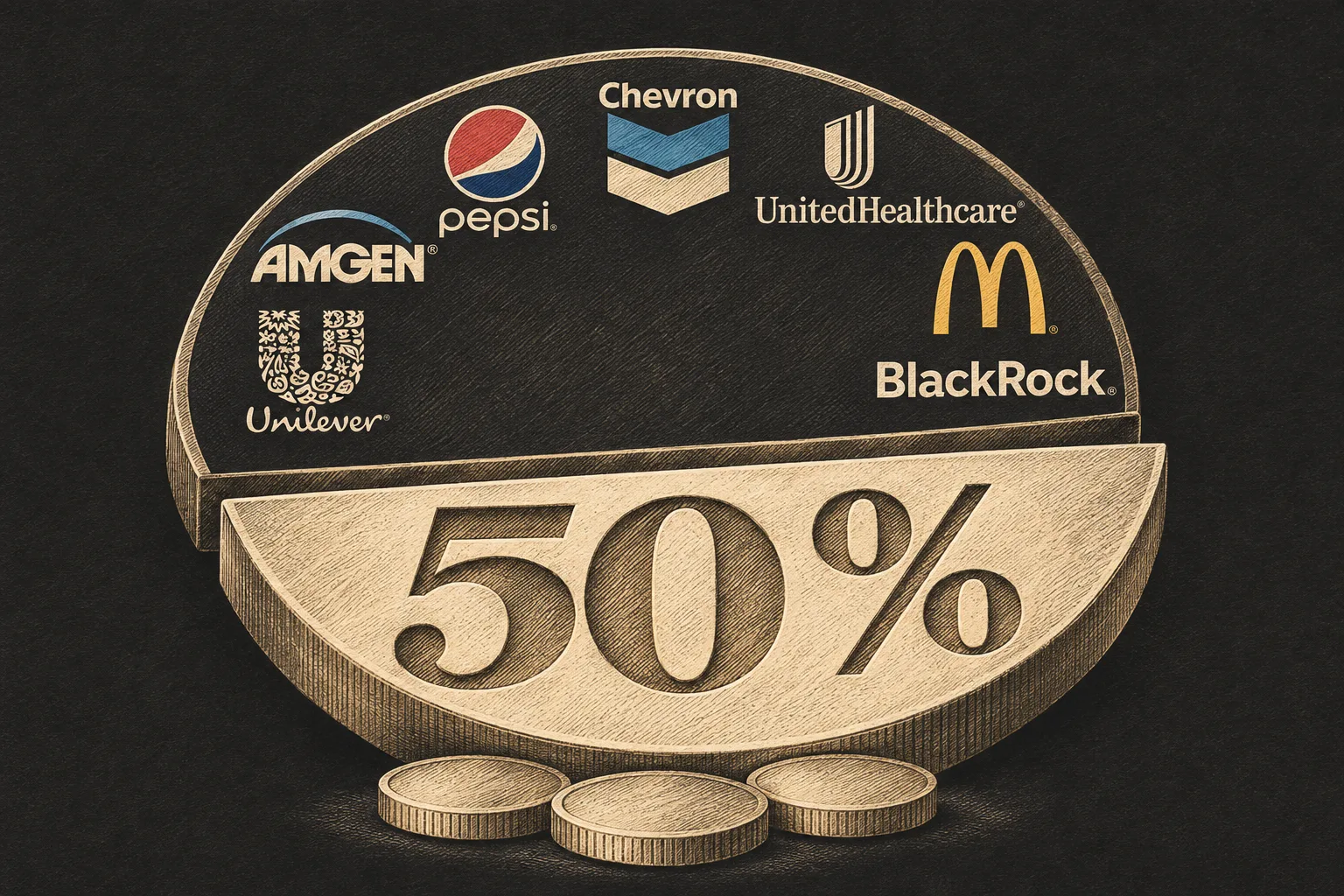
Seven well-known companies pay shareholders at least half of their profits, according to screeners. But a closer look shows that only three actually exceed this threshold. For the others, accounting figures create a misleading picture of their dividend policies.
PepsiCo has increased its dividend for 54 consecutive years and currently offers a yield of around 4.3%. At the same time, however, it spends approximately 77% of its free cash flow on payouts. How long can the dividend keep growing when its core US business is slowing?
One of the largest healthcare companies reports a payout ratio above 50%, yet spends only 36% of its free cash flow on dividends. Its true financial cushion is therefore much larger than conventional metrics suggest.
McDonald's has increased its dividend for more than half a century, and its franchise model generates stable cash. But beneath the surface lie nearly 54 billion dollars in net debt and declining foot traffic at its US restaurants.
One of the seven companies raised its dividend by 10% this year, the fastest increase in the group. Its accounting payout ratio exceeds 50%, while its payout relative to expected earnings is only 37%. Which companies have the most room for further dividend growth, and which are already running up against their limits?
Dividend investors usually start with yield. More experienced investors, however, focus mainly on what the dividend is paid from. That's where the payout ratio comes in: the share of profits a company pays to shareholders as dividends. Values around 30 to 40% are typical of companies still investing heavily in their own growth. The 50% mark separates companies that are already returning most of their earnings to owners.
At first glance, this looks like a group of reliable dividend payers. In reality, each rests on a different economic foundation.
Why the payout ratio alone isn't enough
The conventional payout ratio is calculated using accounting earnings over the past 12 months. But these include amortization of intangible assets from acquisitions, one-off gains from the sale or spin-off of divisions, and exceptional expenses. When earnings are temporarily depressed, the payout ratio jumps even if the dividend itself hasn't changed. That's why we compare three measures for each company: the ratio based on historical earnings, the ratio based on expected earnings over the next 12 months, and dividends as a share of free cash flow, which shows whether the payout is backed by actual cash.