
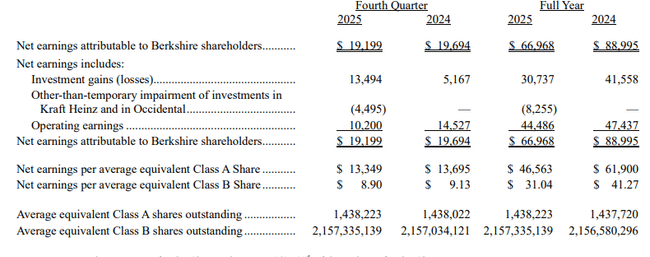
Berkshire Hathaway’s latest financial release delivered a powerful mix of numbers that surprised many market observers. In the fourth quarter of 2025 Warren Buffett’s final quarter as CEO the conglomerate reported operating profit of about $10.2 billion, down roughly 30 percent from $14.5 billion a year earlier as insurance underwriting income softened and investment gains fluctuated. This decline, detailed by multiple financial outlets, marked one of the most significant year-over-year drops in recent history for the company’s operating earnings while also underscoring how much weight insurance profits carry in Berkshire’s overall results.
Insurance woes and writedowns drove the decline
A closer look at the numbers reveals that insurance underwriting profits fell sharply, with property and casualty operations such as GEICO and reinsurance seeing pretax earnings tumble as pricing pressures and higher accident claims squeezed margins. Lower interest rates also reduced investment income on Berkshire’s massive cash reserves, compounding the earnings hit. On top of this, the company recorded a multi-billion dollar writedown on long-held investments in companies including $OXY and $KHC, which further weighed on consolidated results for the period.
Net income held up better but still edged lower
Despite the drop in operating profit, Berkshire’s net income remained relatively resilient, falling only modestly compared to the sharp operating earnings decline. The company reported net income of roughly $19.2 billion for the quarter, a slight decrease from $19.7 billion in the same period a year earlier, illustrating how investment performance including unrealized gains can buffer headline profitability in volatile markets. This divergence between operating and net income highlights a structural feature of Berkshire’s results: profit driven by stock market valuations can offset near-term operational weakness.
Full-year 2025 shows broader earnings pressures
On an annual basis, Berkshire’s operating earnings for 2025 totaled about $44.5 billion, down from approximately $47.4 billion in 2024, reflecting the cumulative impact of softer insurance markets and cyclical headwinds in key segments. Net earnings for the year also slid significantly a roughly 25 percent decline compared with 2024 partly driven by lower overall investment gains and the writedown charges mentioned earlier. These full-year figures paint a picture of a company navigating both cyclical pressure points and a changing macroeconomic backdrop as it transitions leadership.
Cash reserves remain huge, giving new CEO strong firepower
One of the standout numbers from the release was $BRK-B's cash and short-term investments position about $373.3 billion at year-end, among the largest war chests in corporate America. That enormous liquidity base provides incoming CEO Greg Abel with extraordinary optionality for acquisitions, strategic investments, or opportunistic deployment in periods of market dislocation. Abel and company leadership have repeatedly emphasized that they are prepared to put this cash to work where it will create long-term value for shareholders, even as share buybacks remain suspended and no dividends are planned.
Segment performance reveals mixed strength across the conglomerate
Berkshire’s sprawling business portfolio delivered a mixed set of results in the quarter. While insurance profitability stumbled, other segments showed resilience. The BNSF railroad reported solid profit performance, and manufacturing, services, and retail businesses posted modest growth. Energy operations saw a slight decline, reflecting broader commodity price and demand trends. Some well-known consumer brands within Berkshire’s umbrella including Duracell and select retail holdings faced weaker demand, reflecting softness in end-market spending patterns. These variations illustrate the diversified nature of Berkshire’s earnings base, where one segment’s weakness can be counterbalanced by another’s relative strength.
Source:https://www.berkshirehathaway.com/news/feb2826.pdf
Investment gains and losses tied to equity holdings remain significant drivers of Berkshire’s bottom line, and the 2025 results were no exception. While the conglomerate saw net realized and unrealized gains in select holdings, significant impairment charges on others particularly that large Occidental stake moderated overall performance. Because Berkshire reports investment gains and losses in net income but excludes them from operating profit, the reported net results can sometimes mask underlying operational trends, a nuance that investors should consider when interpreting quarterly performance.
Transition leadership under Abel maintains Buffett legacy with a cautious outlook
The earnings release coincided with the transition to Greg Abel as CEO, a milestone in Berkshire’s storied history after Warren Buffett’s six-decade leadership. Abel’s first annual letter to shareholders reinforced the company’s traditional investment discipline and decentralized operating model, while underscoring confidence in Berkshire’s long-term prospects despite short-term earnings pressures. The combination of record cash reserves, diversified business segments, and a commitment to value-focused capital allocation sets the stage for how Berkshire may navigate the next chapter balancing legacy with strategic opportunity. (Greg Abel’s leadership message reinforces continuity.