
On March 24, Arm Holdings ended 35 years of pure licensing at an event in San Francisco, unveiling the AGI CPU, its first chip designed and sold directly under its own brand, purpose built for AI inference and agentic AI workloads in data centers. The chip features up to 136 Neoverse V3 cores per unit drawing 300 watts, delivers twice the performance-per-watt versus x86 designs, and allows a single air-cooled rack to house 64 units totalling 8,700 cores, with Meta Platforms as lead development partner and first major customer alongside OpenAI, Cerebras and SK Telecom, manufactured by TSMC and available from ODMs including Super Micro and Quanta in volume from H2 2026.
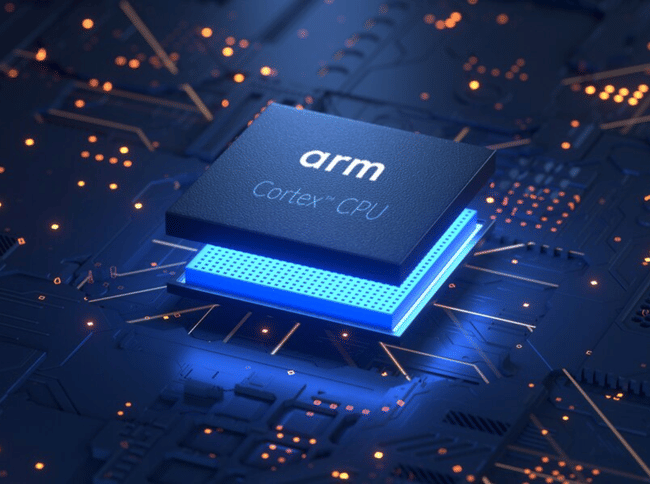
The financial ambition behind the launch is significant. CEO Rene Haas told investors ARM targets 25 billion dollars in total annual revenue and CFO Jason Child confirmed the AGI CPU carries a roughly 50 percent gross margin, with analysts projecting the chip product line alone could contribute 15 billion dollars in annual revenue by 2031 as Haas forecasts a fourfold increase in CPU demand driven by agentic AI workloads requiring continuous inference rather than periodic query responses. The move is a direct bet that entering hardware will expand Arm's addressable market to customers who never engaged with its IP licensing model, though it also places the company in direct competition with longtime licensees like Nvidia, Qualcomm and AMD, who attended the launch and offered endorsements while knowing they now share a customer pool with their foundational supplier.
What AGI CPUs can really do
The chip is built on Neoverse V3 cores and offers up to 136 compute cores per processor. Arm claims performance over 2x higher per rack compared to classic x86 CPUs from Intel $INTC or AMD $AMD, and with significantly lower power consumption. A single air-cooled rack holds up to 64 AGI CPUs, for a total of over 8,700 cores - a compact configuration that targets power-constrained data centers.
The economic argument is also important: Mohamed Awad, head of Arm's cloud AI business, has calculated that deploying AGI CPUs can save up to $10 billion in building a single large AI datacenter at a cost of around $50 billion. At a time when hyperscalers like Meta $META, Microsoft $MSFT or Amazon $AMZN are planning AI infrastructure investments in the hundreds of billions, this is an argument that executives are hearing.
Chip production is entrusted to TSMC $TSM on a 3nm process - the same technology that underpins Apple's most advanced chips $AAPL or Nvidia's $NVDA. Arm has already received test samples that work as expected, and mass production is planned for the second half of 2026.
Meta as the number one partner
Arm is not alone behind the development of the AGI CPU. Meta Platforms has become a major partner and co-developed the chip directly with Arm. The goal is specific: Meta wants to deploy the AGI CPU alongside its own MTIA chips to more efficiently manage the large-scale AI systems powering Instagram, Facebook, WhatsApp or Llamas.
But the customer base for the new chip goes beyond a single company. Early customers include OpenAI, Cloudflare, SAP and SK Telecom, with Arm in talks with other hyperscalers. On the server manufacturer side, Arm is working with Lenovo, Quanta Computer and Supermicro, which are preparing complete server systems based on AGI CPUs.
A breakthrough in a business that has been around for 35 years
The move from a pure licensing model to selling its own chips is a strategic earthquake for Arm. Until now, the company has lived off royalties, a percentage of each chip sold by customers. That model delivered steady revenue without manufacturing risk, but it also limited maximum growth potential - Arm earned a fraction of the value its technology generated in chips from Apple, Nvidia or Qualcomm.
The new model brings higher margins, but also higher risk. For the first time, Arm is in direct competition with its own customers. Intel, AMD and, in a sense, Nvidia are now competitors of the company whose design instructions they also license. Haas doesn't hide this paradox - he talks about it openly and says the market is big enough for everyone.
The numbers and outlook for investors
Arm has consistently beaten analysts' estimatesin recent quarters. In the third quarter of fiscal year 2026, it reported revenue of $1.24 billion, up 26% year-over-year, and it was the fourth consecutive quarter with billions in revenue. For the full fiscal year, Wall Street expects net income of $1.75 per share on revenue of $4.91 billion.
AGI CPU hasn't yet fully factored the potential of the new segment into those estimates. Arm says the custom chips will add "billions of dollars" to annual revenue - a specific number is not yet in question, as mass shipments don't start until the second half of 2026. The next chip in the new family is expected to be 12 to 18 months out, and Arm plans a regular iteration cycle similar to Nvidia's with its GPU architectures.
For investors, the AGI CPU signals a structural change in Arm's valuation story. The company is moving from being a mere licensing company with a limited revenue ceiling to becoming a direct player in the most lucrative AI hardware segment. The question remains how key licensing customers - Apple, Qualcomm or Nvidia - will react to the fact that their supplier has turned into a competitor.
Scenarios and projections: where the numbers are heading
The basic Wall Street consensus is working with revenues of $4.91 billion for the current fiscal year and $6 billion in 2027. By 2030, analysts are projecting revenues of around $12 billion on average, with more optimistic models working with a figure of over $15 billion. AGI CPU does not yet fully incorporate the potential of the new segment into these estimates - mass shipments only start in the second half of 2026, and the first full fiscal year with a chip on sale will not be until 2027.
The key structural argument comes from data centers. Arm has more than doubled revenue from this segment year-over-year in recent quarters, and analysts estimate that Arm-based processors could power up to 50% of new CPU installations at the largest hyperscalers by the end of 2026. Server CPU royalty revenues are growing at a rate of over 76% annually and are expected to reach approximately $4 billion from this segment alone by fiscal 2031, according to analyst estimates.
Net income is growing even faster than revenues. From $792 million in 2025, analysts model a jump to $1.8 billion in 2026 and $2.3 billion in 2027, while EBITDA is expected to approach $6 billion by 2030, which would put Arm among the most profitable semiconductor companies in the world.
A consensus of 27 analyst houses puts the 12-month target price at $156, with the highest bull case going as high as $170. But Wells Fargo warned in February 2026 that the consensus estimate of royalty earnings growing 27% annually may be too optimistic - and this is where AGI CPU enters the picture as a variable that skews existing models in both directions. If the chip sees rapid adoption by hyperscalers, estimates will have to be rewritten upwards. If customers react to Arm's direct competition by limiting licensing, the equation may reverse.
Three scenarios for the next 18 months look like this:
Bullish: Meta, OpenAI and other AGI CPU customers deploy quickly, Arm reports first billion-dollar revenue from direct chip sales in H1 2027, royalty revenue simultaneously grows due to dominance in datacenters, and the stock approaches over $180.
Base case: AGI CPU deployments are gradual, with the first significant revenue contribution coming in FY 2028, revenues arriving at consensus around $6 billion in 2027, and the stock trading in the $140-160 range.
Bearish: Key customers like Qualcomm or Nvidia react to Arm's entry into direct chip sales by limiting investment in new licenses, transition costs for AGI CPUs are higher than expected, and market adoption remains slow - sales disappoint consensus and the stock tests levels below $120.