
Chevron for 1Q 2026 at first glance reports a drop in net income to USD 2.2 billion (USD 1.11 per share) from last year's USD 3.5 billion (USD 2.00 per share). But after adjusting for one-time items and accounting "timing" effects, the company earned $2.8 billion, or $1.41 per share, beating analysts' consensus set at $0.95 by about 46%.
Revenues of USD 47.56 billion hit expectations almost exactly (USD 47.54 billion), but remained roughly flat year-on-year and operating margin fell from 12.2% to 4.6%.
Production: Hess drives growth, Tengiz puts the brakes on volumes
The upstream segment remains a key driver. In 1Q 2026, Chevron earned $3.9bn in upstream, up about 4% from a year ago, primarily due to higher oil prices. Production in the United States rose 388k b/d of oil equivalent - driven by the Hess (Guyana) acquisition and higher production in the Gulf of Mexico and Permian Basin.
International upstream production added another 117 thousand barrels per day, again mainly driven by Hess, but some of this gain was erased by outages at the Tengizchevroil consortium in Kazakhstan. Due to the fire at the Tengiz field, total production pulled back slightly to 3.86 million barrels of oil equivalent per day from the previous quarter, although it still remains in the 3.8-3.9 million barrel range that management had indicated ahead of the results.
On a positive note for investors, US production exceeded 2m b/d for the third consecutive quarter, confirming the portfolio's shift towards safer jurisdictions and high-margin production in the Permian and Guyana.
'Counterfeit' derivatives: $2.9bn accounting noise set to return
The main reason why reported earnings are down year-on-year is not fundamentals, but accounting timing. Chevron already warned in its April 8-K that it expects negative after-tax timing effects of $2.7-3.7 billion in the downstream segment due to mark-to-market losses on revalued derivatives and the impact of LIFO inventory accounting.
These items arise because the firm must revalue financial derivatives at current market prices before it physically sells the commodity to which they are linked, while at the same time accounting for inventories at historical (lower) purchase prices. As a result, in an environment of soaring oil prices, accounting "punishes" results in the short term, even when cash flow and economic reality look better. Management expects this loss to gradually reverse in subsequent quarters as physical deliveries occur and inventories are revalued.
CFO Eimear Bonner pointed out that roughly $1bn of these positions are expected to close and deliver profits as early as 2Q 2026. Adjusting for these effects, Chevron is thus reporting higher quarter-on-quarter profits due to rising production and improving refining margins.
US-Israel vs. Iran oil war: Brent above $120 and a boost for upstream
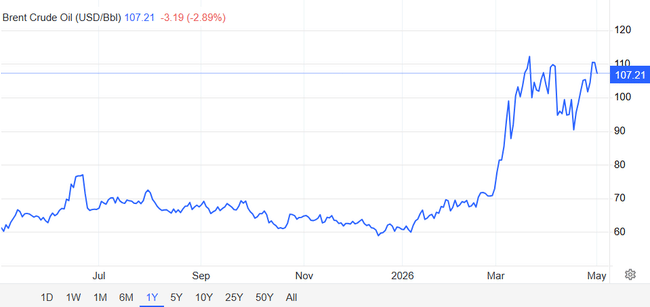
The results come at a time when the oil market has experienced its sharpest rise since the pandemic. Both Brent and WTI prices have jumped roughly 60% since the start of the US-Israeli war against Iran on February 28. According to CNN, Brent briefly touched $126.41 a barrel before correcting to around $115-116.
Chevron said the rise in Brent alone from around $62 in early January to over $100 at the end of March will add $1.6-2.2 billion to upstream earnings compared to the previous quarter. The high prices are a direct result of the blockade of the Strait of Hormuz, through which around a fifth of the world's oil and LNG supplies normally pass, and where daily tanker numbers have plunged to units since the conflict broke out.
Cash flow in the red: working capital and a generous payout mix
The weakest point of the report is cash flow. Free cash flow fell to USD -1.5bn in 1Q 2026, while it was +USD +5.5bn in 4Q 2025 and +1.3bn a year ago. Operating cash flow was US$2.5bn (vs. US$10.8bn in 4Q 2025), with a key role played by an increase in working capital in the form of receivables from higher oil prices - the money is "earned" on the books but hasn't physically arrived yet.
Bonner predicts that operating cash flow will continue to be weighed down by expected working capital outflows in the US$2bn-US$4bn range in the coming quarters until oil market and payment conditions stabilise. However, despite the negative FCF, Chevron paid out US$3.5bn in dividends and repurchased US$2.5bn of its own shares in 1Q 2026. Buybacks were slightly lower than in the previous quarter, but the company continues to target an annual range of USD 10-20bn in buybacks.
The board confirmed a quarterly dividend of $1.78 per share, payable on June 10, 2026, which follows a 4% dividend increase announced at the 4Q 2025 results. This confirms Chevron's image as the "dividend aristocrat" of the oil sector, maintaining payout discipline even in a period of higher volatility.
Management: volatility is accounting noise, core business is going
Commenting on the results,CEO Mike Wirth stressed that despite heightened geopolitical volatility and supply disruptions, the company delivered a "solid performance" in 1Q, confirming the resilience of its portfolio. Bonner also asked the market to separate short-term accounting effects from the core business, which it said was showing earnings and cash flow growth and progressing according to plan.
For investors, several key points follow:
Reported EPS looks weak, but adjusted numbers show a significant beat to expectations and rising upstream profitability.
Upstream growth in the US (Permian, Gulf of Mexico) and Guyana via Hess is shifting the portfolio towards premium low-cost barrels in safer regions.
Negative timing effects and working capital distort the cash flow picture in the short term, but management explicitly announces a partial reversal in 2Q and beyond.
Chevron is using the oil boom to maintain a generous dividend and massive buybacks, even at the cost of temporarily negative free cash flow.