
The new Google Health app is set to make Google a universal AI health and fitness coach that won't just be locked into Fitbit or Pixel Watch, but will gradually learn to work with Apple Watch, Oura, or Garmin.
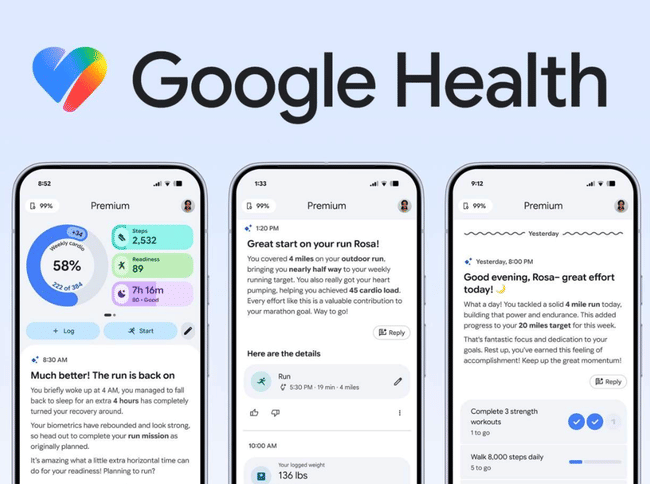
Instead of fighting for every wrist in a crowded wearables market, Google is trying to occupy a higher tier - to become the "brain" that brings together data from different devices, analyzes sleep, movement and other biometrics, and is the first to answer questions like "how am I doing health-wise?" At a time when millions of people are asking health questions directly to chatbots, it's a safe bet who will become the main AI layer above personal health.
What Google is launching: Google Health and AI Coach
Starting May 19, the Fitbit app will be renamed Google Health, and at the same time, AI Health Coach, built on Gemini models, will go into full swing. The latter has:
Summarize health and fitness data that the user voluntarily shares with it
create personalised weekly plans (movement, sleep, recovery)
act as a chatbot that answers questions about the custom data (e.g. why I feel worse after a certain workout, how my sleep has changed)
Google $GOOG is also launching a new Fitbit Air wristband - a simple "screenless" tracker without a display that serves only as a sensor connected to an app. But the main product is not hardware, but a paid Google Health Premium service: most of the advanced AI coach features (detailed summaries, plans, long-term trends) will be available just within this subscription, separate from Google's other AI plans.
AI Coach is meant to function as a digital version of the team that elite athletes have - nutritionist, trainer, sleep coach - in just one app. It can point out, for example, that a four-mile run topped a weekly goal of 20 miles, or that a few nights of longer sleep improved recovery indicators.
An open ecosystem: "brains" over Apple Watch and other devices
Google's strategy differs from the classic "locked down" approach. Google Health can already work with data from other apps today; through tools like Health Connect (Android) and Apple HealthKit, it wants to gradually connect AI coaches to Apple Watch, Oura, Garmin and other devices. At the moment, AI Coach is only available for Fitbit and Pixel Watch, but the goal is to expand support within a year.
From a user perspective, that means:
hardware he can keep - Apple Watch, another Fitbit, a smart ring
Google will "sit" above it as an analytics layer
data from different sources converges in Google Health and an AI coach builds recommendations on top of it
This is key for Google as it lags behind Apple, Samsung and Chinese brands in the wearables market alone. If it manages to become a software superstructure over someone else's hardware, it can gain influence over how people use AI in health without having to win the battle for every wrist.
Competition: Microsoft, OpenAI and specialist players
Google is not alone in trying to become the "first AI" that people turn to with health questions.
Microsoft $MSFT in March launched Copilot Health, which combines data from dozens of wearable devices with electronic health records to help evaluate trends, explain lab results and prepare questions for doctors.
OpenAI launched ChatGPT Health, a mode that integrates medical records and data from wellness apps to make answers more contextual and tied to specific user history.
Specialized competitors are adding AI layers to this as well: Samsung is expanding health on the Galaxy Watch, and Oura and Whoop are adding AI comments on HRV, sleep and recovery. They're all aiming for the same goal - to become the default service where users consolidate their health data and to which they return with further queries.
Google is trying to differentiate itself with a combination of its own models (Gemini), Fitbit's experience and open access to third-party devices. Instead of "buy our watch" it says "use any hardware, we'll add brains to it".
AI coach not doctor: benefits and limits
Major healthcare institutions repeatedly warn that AI in health has limits: it can't physically examine, often lacks context, and can generate compelling but flawed advice. That is why Google - like Microsoft and OpenAI - presents its products as a complement, not a replacement for the doctor.
Real-world use of an AI coach makes sense in situations like:
tracking sleep, weight, heart rate and activity trends
identifying links between lifestyle and subjective well-being
preparing for a doctor's visit (symptom summary, questions, history)
The risk occurs if the user mistakes a "wellness tip" for a diagnosis or if the model evaluates a common deviation as an alarming problem. Google therefore needs to address clear boundaries alongside model development: communicate that the AI coach is not a diagnostic tool and that for serious problems, the health system should be the first choice, not the chatbot.
Why it is crucial for Google to be first
From a business perspective, it's about dominating the entry point. If Google Health becomes the first place a user reaches when addressing sleep, fitness or blood pressure, there will be strong inertia:
Switching to a competitor means re-setting data sources and "learning" a new coach's history
Google gets a very rich temporal dataset on health and habits
that can be used for other services, partnerships and model improvements
Thus, in AI health, Google is not really competing primarily for bracelet sales, but for its AI layer to sit on top of as much health data as possible - even that collected by hardware from Apple or other competitors. If it succeeds, it can succeed in the health AI race, even if it never wins the wearables sales charts.