
Nvidia stopping H200 production for China sounds like a retreat, but it can also be a business decision. If export uncertainty makes China sales hard to plan, the worst outcome is to “waste” scarce foundry slots on chips that might not ship. Reports say Nvidia is reallocating that manufacturing capacity at TSMC toward its next platform, Vera Rubin, where demand and pricing can be stronger and more predictable.
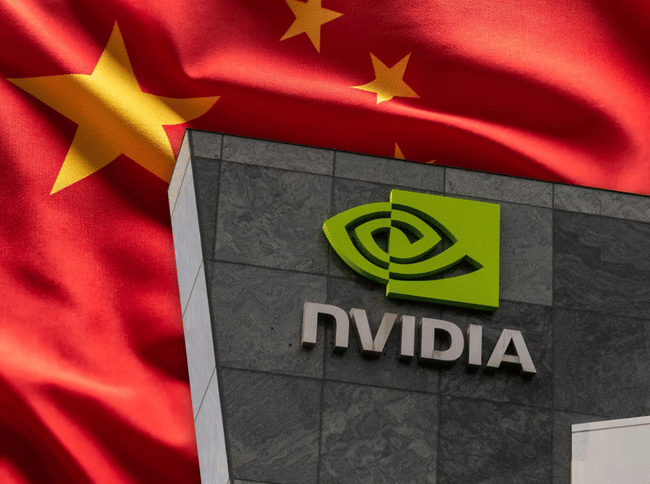
The investor question shifts from “lost China revenue” to “where does the capacity go next.” If the same wafers are redirected to higher-margin products for the US and allied markets, Nvidia can protect average selling prices and margins even with lower China exposure. Meanwhile, Chinese customers still need compute, so the pressure moves downstream: domestic alternatives, smaller approved imports, and slower buildouts until supply becomes clear.
What Nvidia is realistically losing
On paper, the Chinese market looks like a goldmine that no company wants to lose. Nvidia's $NVDA had an order outlook for H200s in the range of over a million units, with Chinese tech firms set to buy its AI chips for roughly $13.8 billion in 2026 alone (up from roughly $11.7 billion in 2025). At roughly $27,000 per H200, that's a potential for sales in the lower tens of billions of dollars per year if the political environment remains calm.
But it is not. Chinese authorities have begun blocking H200 shipments at customs, suppliers in China have halted component production, and the United States, meanwhile, is further tightening export rules for high-end AI chips. Nvidia has therefore concluded that much of these Chinese sales are an illusion - a politically conditioned "pipeline" that cannot be reliably monetized. Thus, from an economic perspective, it "loses" a primarily hypothetical future in a segment where it has no certainty of supply or payment.
How Nvidia will make more money by moving capacity to Vera Rubin
A key move is the redirection of TSMC's $TSM manufacturing capacity from the H200 to a new generation of chips known as Vera Rubin (Rubin R100). These GPUs are to be manufactured on TSMC's advanced 3nm process and use HBM4 memory, representing a significant leap in both performance and efficiency over the H200. So any wafer that doesn't turn into an H200 for insecure China could become a Rubin chip for a hungry datacenter in the US or Europe - and at a higher price and margin.
Nvidia has already surpassed the $100 billion annual revenue mark, with datacenter AI GPUs being the main driver and analysts expecting further growth in 2026. According to management comments, the company has an order book in excess of $500 billion, which it still considers a conservative estimate of demand. So moving capacity from H200 to Rubin is not just a technology upgrade, but a financial decision: to prioritize customers with the highest willingness to pay and lowest political risk, rather than fighting for the complicated Chinese market.
The impact on China and the global AI ecosystem
For China's AI ecosystem, the H200 shutdown is very painful. Big players like Alibaba $BABA, Tencent $TCEHY and ByteDance were planning huge investments in Nvidia infrastructure, as these chips are the standard for training and deploying the largest models. Without access to the H200 (and subsequently the Ruby generation), they will have to rely more on homegrown chips and optimize models on less powerful hardware, which may slow the pace of their AI innovation in the short term.
At the same time, however, this pressure will accelerate China's drive for self-sufficiency in high-end chips. As before in mobile networks and cloud services, limiting access to Western technology may paradoxically strengthen domestic AI processor champions. At the global level, Nvidia's strategy will then further reinforce its dominance in the US and Europe, where Ruby GPUs will form the basis of new AI infrastructure, drawing the attention of regulators concerned that one company holds the "oxygen" for the entire AI economy.
What this means for Nvidia and the market
In the short term, news of the H200 being discontinued for China is making investors nervous - with headlines highlighting the "lost" Chinese market and the potential billions the firm is "passing on" to competitors. But on closer inspection, Nvidia is trading uncertain sales in a politically risky region for a more secure, profitable business in Western datacenters, plus a new generation of products.
For the global market, the effect is twofold: the West will gain priority access to the most powerful AI chips and further deepen its lead in AI infrastructure, while China will be forced to invest even more aggressively in developing its own chips and alternative ecosystems. So while Nvidia is closing the door on one generation of chips in China, it is also opening a much larger vault - one in which the margins and revenues of the new Ruby era are calculated.