
On March 20, the White House released its long awaited national AI legislative framework, calling on Congress to pass a single federal standard that would preempt the growing patchwork of state AI laws, including those in California, Colorado and New York. The document outlines six guiding objectives for lawmakers: protecting children online, preventing AI enabled scams, streamlining data center permitting so facilities can generate on site power, limiting AI developer liability, preventing government use of AI for censorship and giving the workforce AI training, all framed explicitly as pro-innovation priorities. Crucially, the framework recommends against creating any new federal regulatory body for AI, calling instead for sector specific oversight through existing agencies like the FTC and FCC.
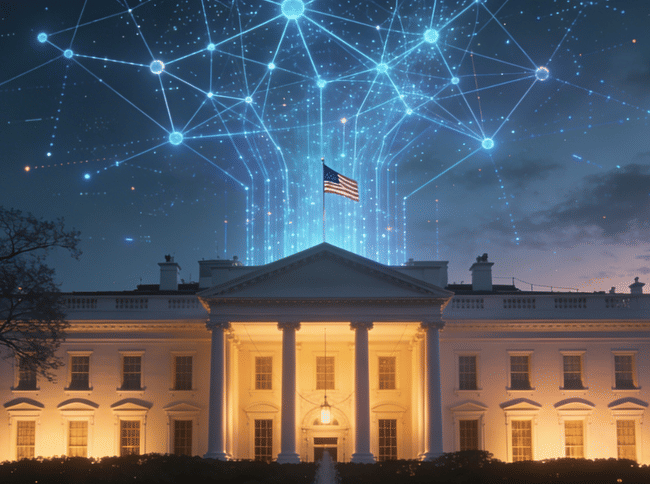
The direct link between the framework and Big Tech lobbying is visible in the numbers. Meta, Alphabet, Nvidia, Amazon, Microsoft and others collectively spent more than 100 million dollars influencing U.S. government AI policy in 2025, the first time that threshold was ever crossed, and the results have been tangible: relaxed chip export controls toward China, fast tracked data center permitting and now a federal framework that explicitly tells Congress not to burden AI developers. Critics, however, point out that the framework leaves some of the most contested questions, including how copyright law applies to AI training data, to the courts rather than Congress, and warn that without clear liability rules the resulting legal vacuum could create uncertainty that ultimately slows enterprise AI adoption and hurts the very companies the policy aims to protect.
What the framework specifically proposes
The White House has structured the framework into six pillars:
Protecting Children and Empowering Parents: Congress should create better tools to manage children's digital presence, especially in the context of AI content and interactions.
Preventing censorship and protecting free speech: the state must not force technology providers to block or edit content based on a political or ideological agenda.
Data centre construction: simplify permitting processes and allow on-site power generation to accelerate the expansion of AI infrastructure.
Fighting AI fraud: strengthening legal tools against AI deepfakes, identity theft and fraudulent schemes using AI.
Fostering innovation and US dominance in AI: removing unnecessary barriers, access to testing environments, and accelerating AI deployment across sectors.
Education and AI-ready workforce: investing in retraining and new jobs in the AI economy.
The most important point is federal preemption of state laws: Congress should prohibit states from regulating the development of AI models, prevent them from holding developers accountable for third-party misuse of their models, and replace the "patchwork of fifty misaligned rules" with a single national standard.
Copyright: the biggest unresolved issue
One of the most closely watched areas is the framework's stance on training AI on copyrighted content. The administration's position is clear: training AI models on copyrighted material does not, in its view, infringe copyright. But the Framework also says that Congress should not intervene in this dispute and should leave the decision to the courts.
This is in direct conflict with Senator Blackburn's current Senate "TRUMP AMERICA AI Act" proposal, which would make training on protected content a fair use violation. For companies like OpenAI, Google $GOOG (Gemini), Anthropic, Meta $META (Llama), and Microsoft $MSFT, this issue is existential: if the courts or a later law determined that training on text, images, and videos without the authors' consent is illegal, these companies would either have to pay massive licensing fees or completely rethink what data they train models on.
The framework also supports the creation of collective licensing platforms where rights holders could negotiate with AI firms as a whole without the risk of antitrust lawsuits. This could lead to a compromise where AI firms pay collective fees for access to content but are not exposed to thousands of individual lawsuits.
What this means for specific companies
Nvidia $NVDA is the biggest direct beneficiary of relaxed AI regulation as a whole. The faster AI data centers grow and the less AI development is hampered by regulation, the more GPUs Nvidia will sell. The streamlining of data center construction and federal preemption of state rules directly removes barriers that may have hindered Nvidia customers from expanding capacity.
Microsoft and OpenAI directly benefit from the framework in two areas: the end of fragmented regulation reduces compliance costs across states, and the stance on copyright (letting the courts decide, not legislatively prohibiting training) gives them room to continue their existing access to training data. Microsoft in 2025 has invested heavily in lobbying for just these positions.
Google, Meta, and Amazon benefit from preemption of state laws that nullifies the situation where they had to pursue dozens of different regulatory environments. Meta in particular has welcomed the stance on open-source model development, as the framework does not explicitly recommend restricting access to model development or imposing liability on developers for how third parties use their models.
Anthropic is in a more delicate position. The company has long profiled itself as a proponent of responsible AI development, and its affiliated group Public First Action has directly criticized the framework as hollow and unresponsive to the technology's actual risks. At the same time, Anthropic lost a contract with the Pentagon precisely because of its refusal to comply with all DoD requirements - in an environment where the White House says "less regulation," Anthropic's position as a "responsible" player is more complicated.
The impact on valuations and numbers of AI companies
As such, the framework is not law and has yet to pass Congress, so the direct impact on companies' financial results is indirect. But it is important for AI sector valuations for several reasons:
It reduces the regulatory risk premium: investors in AI firms had some risk built in that strict regulation (like the EU AI Act) may limit AI deployment and monetization. If the US goes in the opposite direction, this premium shrinks.
Accelerates data center construction: simplifying the permitting and power situation for data centers directly opens up space for faster CAPEX growth for cloud players and higher demand for GPUs and infrastructure.
Eliminates compliance costs: companies operating in multiple states don't have to pay for compliance with 50 different regulatory frameworks.
Opens up commercial AI in regulated sectors: sector-specific regulation (healthcare via FDA, finance via SEC, etc.) is more predictable and will allow AI firms to enter areas such as healthcare, insurance or financial advisory more quickly.
On the negative side, the ambiguity around copyright remains as a "hanging sword" over the whole sector: until the courts decide, companies live in legal uncertainty about the validity of their training data. If a future ruling determines that training on protected content without consent is illegal, it could lead to billions in damages and forced changes in data strategies for some companies.
What to watch next
For investors watching the AI sector, the following signals are key:
How quickly Congress translates the framework into concrete legislation and whether it can get it done before the election.
How the courts rule in ongoing cases around copyright and AI training - particularly the cases against OpenAI, Meta and Google.
whether simplifying data center construction will lead to accelerated CAPEX for AWS $AMZN, Azure, Google Cloud and Nvidia.
how the framework will affect the international competitiveness of US AI firms vis-à-vis the EU, which has taken the opposite approach - tighter regulation via the AI Act.
The most important variable is whether Trump's light regulatory approach will actually help US AI firms in the global race with China, and whether today's framework will become a workable law or remain a political signal with no real legislative force.