
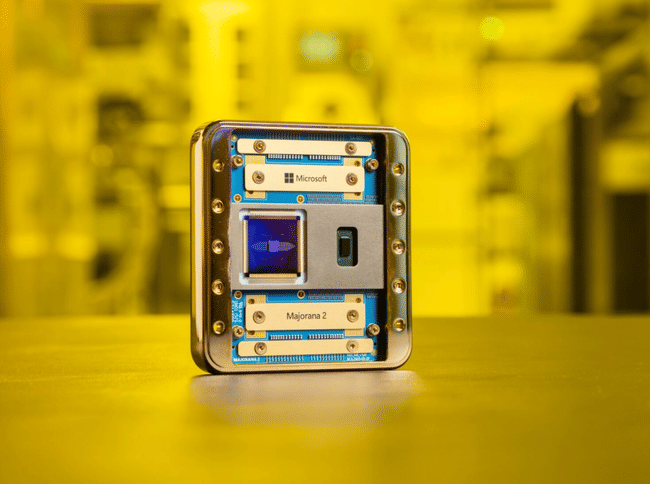
When people talk about the future of technology today, most investors immediately think of artificial intelligence. But there is another race going on alongside AI that could push the entire technology sector forward even more significantly in the long run. It's about quantum computers. Microsoft has now announced a major breakthrough in the development of its new Majorana 2 chip, and claims that a commercially viable quantum computer could emerge as early as 2029.
The new chip is thousands of times more reliable
The biggest problem with quantum computers is not the calculations themselves, but the stability of the so-called qubits. While a classical computer works with bits that take on the value 0 or 1, quantum computers use qubits that can exist in several states simultaneously.
This is why they have the potential to solve problems that are virtually impossible for today's supercomputers. The problem, however, is that qubits are extremely sensitive to their environment. A minimal change in temperature or vibration is enough to cause errors.
Microsoft has now announced that qubits on the new Majorana 2 chip can run for about 20 seconds on average. With the previous generation, it was only milliseconds. The company claims to have achieved roughly a thousand-fold improvement in reliability by doing so. To give you an idea, the company compares this shift to the difference between a phone that needs to be charged every day and one that lasts several years without a charge.
An ambitious plan for 2029
According to Zulfi Alam, vice president of Microsoft Quantum, the company wants to create a quantum computer capable of solving commercially viable problems by 2029. This would mean a significant acceleration in development from most of the expectations of the professional community.
However, it should be added that the current chip contains only 12 qubits. Millions of qubits would be needed for truly practical use. This is where the biggest technological challenge for the industry remains.
However, Microsoft believes it has a significant advantage over its competitors with its unique so-called topological qubit technology.
Twenty years of research and controversy
The development of this technology has not been easy. Microsoft has been working on the concept for more than twenty years and its approach has often been the target of criticism.
In 2018, the company even retracted a scientific study published in the journal Nature that purported to confirm the existence of the Majorana particle on which the entire project is based. At the time, a number of physicists questioned not only the results of the research, but also the very direction Microsoft was taking.
However, the company continued with the development. It introduced the first Majorana chip in 2025, and now comes the second generation, which uses the same principles but offers significantly better results, according to the company. A key change, for example, was the replacement of aluminium with lead as a superconductor.
Quantum race: Microsoft versus Google and IBM
Just as technology companies are competing in artificial intelligence today, a similar battle is also taking place in quantum technology.
The major players include Microsoft, Google $GOOG, IBM $IBM, Amazon $AMZN, IonQ $IONQ and Rigetti Computing $RGTI.
Google, for example, has achieved several significant milestones in quantum supremacy in recent years. IBM, on the other hand, is betting on gradually increasing the number of qubits and building commercial services available via the cloud.
Microsoft differs from its competitors in that it does not rely only on the number of qubits, but more importantly on their stability. If this approach proves correct, it could give the company a significant edge.
What do the experts say?
Professor Paul Stevenson of the University of Surrey has said that Microsoft's timetable is only realistic if the results presented actually match reality. At the same time, he pointed out that if the company succeeds, it could be among the absolute leaders of the industry within a few years.
The fact that Microsoft does not disclose all the technical details of its solution is a source of some scepticism. At the same time, the study published with the announcement has not yet gone through the standard peer review process.
Why are quantum computers so important?
Microsoft cites, for example, the possibility of faster development of fertilisers or solving problems with microplastics and so-called forever chemicals, chemicals that are very difficult to break down in nature.
Connecting AI and quantum computers
Microsoft does not see quantum computers as competition to artificial intelligence. According to company executives, systems could emerge where humans, AI models and quantum computers work together. Artificial intelligence would help design solutions, while quantum computers would perform extremely complex simulations and calculations.
A strategic view
Quantum computers do not yet represent a source of significant revenue. It is still a long-term bet on the future. Yet quantum research can be an important factor in evaluating technology giants. Microsoft has the financial power to invest tens of billions of dollars a year in areas with uncertain outcomes. As with AI, it is the combination of Azure cloud services, artificial intelligence and quantum technologies that may create a new source of growth in the next decade.
Microsoft claims to have taken a significant step towards practically usable quantum computing. The company says its new Majorana 2 chip offers thousands of times more reliability than previous generations and paves the way for its ambitious goal of creating a commercially viable quantum computer by 2029.
Although there are still many question marks around the technology and some in the scientific community remain sceptical, it is clear that the quantum race is gathering pace. If expectations are realised, this could be one of the biggest technological revolutions since the internet.