
When the world’s best-known macro hedge fund materially increases a position in one of the key stocks of this tech cycle, it is rarely a routine portfolio rebalance. Bridgewater Associates’ latest 13F shows it added roughly 1.35 million Nvidia shares, a new buy worth about $253 million, lifting the stake to around $721 million by year-end.

What makes the move stand out is the portfolio context. Nvidia now represents about 2.63% of Bridgewater’s U.S. equity portfolio, which is valued at roughly $27.4 billion, and it is the fund’s largest single stock position in that book. For a shop known for diversification and macro positioning, that level of concentration reads as a deliberate expression of conviction rather than noise.
Nvidia as the backbone of the AI equity cycle
The timing of the purchase is interesting. Shares of Nvidia $NVDA have been virtually stagnant for the past six months and doubts have begun to arise among investors. Revenue growth has still been strong, but the pace is not as explosive as in the early waves of the AI boom. At the same time, there were questions around:
the sustainability of margins
increasing competition (AMD, proprietary hyperscaler chips)
extreme dependence on investments from a few big players
Bridgewater, however, probably sees Nvidia not as a short-term growth story, but as a key infrastructure element of the new technology cycle. Nvidia isn't just a chip maker - it's a de facto "toll collector" on the AI infrastructure highway. As long as companies like Microsoft $MSFT, Amazon $AMZN and Alphabet $GOOG invest tens of billions of dollars a year in datacenter and computing power, Nvidia will remain a central supplier.
From a macro perspective, the fund may view AI as a multi-year capital cycle comparable to the advent of the Internet or cloud computing. In such a scenario, the key is not whether quarterly growth is 35% or 45%, but whether the infrastructure will still be needed five years from now.
Bridgewater Associates
Bridgewater Associates is one of the largest capital managers in the world. It bases its strategies on how growth, inflation, interest rates, currencies and commodity prices are trending. That's why it typically doesn't work by betting only on the success of individual companies, but it composes its portfolio to make sense in different economic conditions. He typically serves mainly large institutional clients, such as pension funds or endowments, and often combines multiple markets at once.
In terms of size, Bridgewater managed roughly $92 billion as of September 30, 2025, according to Reuters. At the same time, it's good to know that some of the information people see in stock position summaries shows only a slice of reality: such summaries capture mostly U.S. stocks, but a significant portion of the overall portfolio may be built on bonds, currencies, and commodities, and those positions often don't make it into lists like this at all.
Portfolio construction: a broader bet on the AI ecosystem
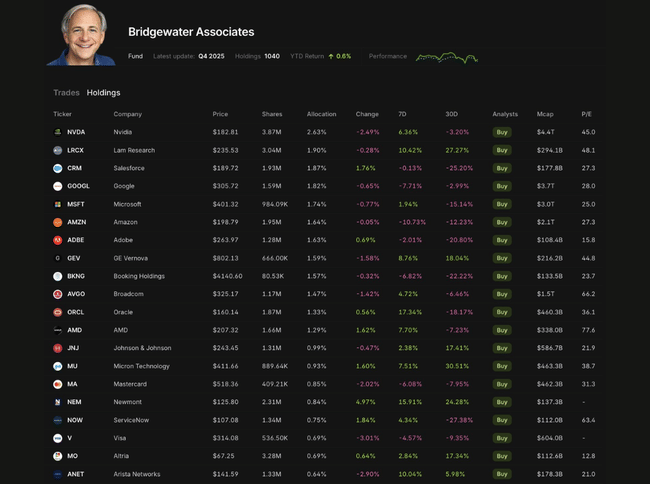
Nvidia is not the only technology pillar in the portfolio. According to available data, the largest positions also include:
Lam Research $LRCX - about 1.90% of the portfolio
Salesforce $CRM - approx. 1.87%
Alphabet $GOOG - approx. 1.82%
Microsoft $MSFT - approx. 1.74%
Amazon $AMZN - approx. 1.64%
Broadcom $AVGO - approx. 1.47%
Oracle $ORCL - approx. 1.33 %
AMD $AMD - approx. 1.29 %
The top 10 positions account for approximately 36% of the entire US portfolio, indicating a relatively concentrated structure, but at the same time not extreme dependence on any one name.
This suggests that Bridgewater is not betting on just one winner, but on the entire value chain:
chip design and manufacturing (Nvidia, AMD, Broadcom)
manufacturing equipment (Lam Research)
cloud and application layer (Microsoft, Amazon, Alphabet)
enterprise software and AI monetization (Salesforce, Oracle)
This is therefore a comprehensive thematic exposition, not a one-sided speculation.
Active rebalancing: what can the fund track?
The latest 13F report shows:
191 new purchases
Increases in 450 positions
full exit from 165 titles
reductions in 395 positions
Portfolio turnover of about 29.5%(Portfolio turnover measures how much of a portfolio a fund has exchanged - i.e. bought and sold- over a period of time - usually a year.)
This suggests high activity and portfolio adjustment to changing macro conditions. In particular, Bridgewater may respond to:
Expectations of interest rates and inflation
The phase of the business cycle
Capital flows between sectors
Valuation extremes
Nvidia's raise may be a combination of structural belief in AI and tactical exploitation of a period of relative price stagnation. If the fund believes that the next wave of AI monetization (e.g., enterprise applications, autonomous systems, robotics) is yet to come, it may view the current valuation as an attractive entry point.
Risks that cannot be ignored
Despite the strong story, there are obvious risks:
Hyperscalers may limit capex if the economy slows.
Competing solutions (Google, Amazon or Microsoft's own chips) may gradually reduce dependence on Nvidia.
Geopolitical constraints (e.g. export restrictions on China) may hit growth.
A macro fund like Bridgewater is aware of these risks. That's why Nvidia is only 2.63% of the portfolio, not the dominant double-digit allocation.
What investors can take from this
Bridgewater's move is not a speculative shot, but a strategic allocation to core AI infrastructure. Combined with exposure to Microsoft, Amazon and Alphabet, it is a thoughtful bet on the continued digitization and automation of the economy.
For the individual investor, the question of time horizon is key. If one expects quick gains in a matter of months, Nvidia may look expensive and sentiment-sensitive. But if one believes that the computing intensity of the economy will continue to grow in five years, then it makes sense to see why the world's largest macro fund is strengthening that particular position.
With this move, Bridgewater is making it clear that it believes the AI story is not over. Rather, it is entering the next phase - less euphoric but structurally deeper.