
Netflix did not buy Warner Bros. Discovery, yet it still ended up with a large cash payment. The reason is simple: Netflix had an earlier agreement linked to WBD, and when WBD switched to a higher offer from Paramount Skydance, the contract triggered a termination fee. That fee was $2.8 billion.
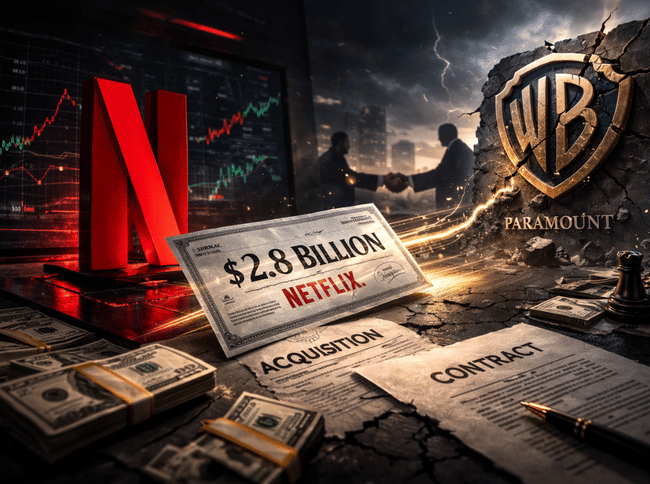
The interesting part for investors is what this says about negotiating power. Netflix did not take on integration risk, debt risk, or regulatory fights. It stayed focused on its core business and still got paid for being a credible bidder. Reports also say the fee was covered by Paramount Skydance as part of the improved package, rather than coming out of Netflix’s pocket or requiring Netflix to build anything new.
How it became a "win" for Netflix
The basic mechanics are simple. Netflix $NFLX had a deal with Warner $WBD to buy its studio and streaming assets at a price Warner deemed fair until Paramount came in with a higher offer. Netflix refused to bid up to Paramount's level and walked away from the fight. Warner then, by contract, had to terminate the original deal - triggering the $2.8 billion breakup fee that is key to the whole puzzle.
Paramount took on that fee and paid it directly following the termination of the deal. In other words: Netflix didn't get "damages" because it was wronged, but because the deal was written so that Warner couldn't simply walk away without a price for changing partners. And because Paramount needed to convince Warner to take its offer, it paid that extra bill as well.
For Netflix, this is an extra win in two layers. The first is cash and immediate. The second is strategic: Netflix avoided taking on the integration risk, debt burden, and regulatory wrangling associated with one of the biggest media mergers of the decade - but still benefited from the escalating prices in this auction. Even analysts in the media are framing this as Netflix "jacking up the price" of the Warner war by design, and it is the new Paramount-WBD conglomerate that will have to foot the final bill to defend the financing and synergies.
Why this is an expensive joy for Paramount and Warner in turn
The winner of the acquisition now has a whole different world to deal with. The deal is worth roughly $110 billion (equity value of around $81 billion), according to the companies, and targets a close in the third quarter of 2026. Paramount and Warner are promising more than $6 billion in savings, but those synergies aren't "free" - in practice, they usually mean big changes in organization, technology and costs, which often translate into restructuring costs and political pressures in the early years.
At the same time, financing shows how tough a discipline this will be. According to Reuters, it is a combination of about $47 billion in capital from investors and $54 billion in debt obligations from banks and other partners, plus a planned rights offering. That's exactly the kind of environment where every extra billion - including the breakup fee for Netflix - adds pressure for synergies to really kick in and for the new company to be able to stabilize cash flow quickly.
That's where regulation and politics come in. In the US, there is already advance talk of a tough review in California, and there are concerns about further concentration in Hollywood, including criticism from unions. At the same time, there is commentary that Paramount has strong political ties, which may be seen as an advantage - but it also increases the visibility of the deal and the risk of it becoming a symbolic battle for media power.
What this means for investors and what to watch next
For Netflix, the bottom line is straightforward: the company takes home cash from the whole episode while confirming that it can play hardball in M&A chess without having to complete the transaction itself. The key will be how Netflix handles such one-time revenue and how the market "clears" it when looking at long-term margins and cash flow - because one-time fees are not a repeatable business, but they can improve flexibility in content investments or buybacks.
For Paramount-WBD, on the other hand, it's a test of execution. Investors will be looking at three things: how quickly the promised 6+ billion in savings start to materialize, how the regulatory process sets the terms (and potentially how expensive they will be), and how much the company's debt sensitivity to rate and ad market developments will rise post-merger. In that optic, the 2.8 billion almost seems like a detail for Netflix - but for the buyer, it's another reminder that the price of winning the Warner war is not paid in one sum, but in a series of "mandatory surcharges" along the way.