
Intel is attaching its turnaround story to one of the boldest ideas the chip industry has seen in years. By joining Elon Musk’s Terafab complex alongside Tesla, SpaceX and xAI, the company is pitching itself as a core supplier of processors for a future in which AI data centres and humanoid robots soak up orders of magnitude more computing power than today. Management is selling the move as a way to bring Intel’s design, manufacturing and advanced packaging under the same roof as Terafab’s one‑terawatt ambition – effectively a bid to prove that the group can still build bleeding‑edge silicon at the scale Musk is sketching out.
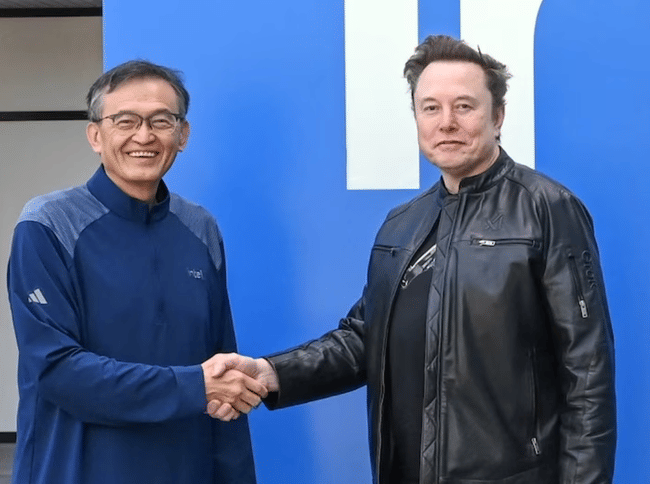
The market has rewarded the narrative shift, at least initially. Intel’s shares jumped more than 2–3% on the announcement and are now roughly 35% higher since the start of the year, helped by earlier optimism around AI‑focused Xeon chips and fab restructuring. To underscore the symbolism, the company pushed out a photo of chief executive Lip‑Bu Tan shaking hands with Musk on its California campus and stressed that the deal caps off months of talks – a visual way of saying that, this time, Intel intends to be inside the next big AI build‑out rather than watching it from the sidelines.
Intel and Terafab: target one terawatt of computing capacity per year
Terafab is a new chip manufacturingcomplex being built in Austin, Texas, to serve as a vertically integrated facility covering the entire process from design to manufacturing to testing. Tesla $TSLA, SpaceX, and xAI, a company recently integrated into the SpaceX structure, are collaborating on the project to provide enough chips for autonomous cars, humanoid robots, and future space data centers.
Elon Musk unveiled Terafab in March 2026 with the ambition of producing chips with a total of one terawatt of computing capacity per year, multiples of current global production of advanced AI chips. The project is estimated to cost at least twenty to twenty-five billion dollars, with some analyses putting the final cost as high as thirty-five to forty-five billion dollars.
The complex is to include two high-tech factories: one focused on chips for Tesla electric cars and Optimus humanoid robots, the other designed for chips destined for data centres in space. At the same time, analytical estimates warn that Tesla's long-term plans to produce tens of millions of robots a year could mean demand for hundreds of millions of highly specialised chips, far exceeding the current production capacity of traditional suppliers.
Strategic context: the merger of SpaceX and xAI and the planned IPO
Intel $INTC 's entry into Terafab fits into Elon Musk's broader strategy to build a self-sustaining technology ecosystem for both artificial intelligence and space projects. SpaceX recently completed its acquisition of xAI in a transaction that was reportedly valued at more than $1 trillion and is one of the largest deals in the history of the technology sector. The structure of the deal allows xAI shareholders to convert their holdings into SpaceX shares according to a pre-determined ratio, bringing artificial intelligence activities under one roof.
SpaceX has also filed a confidential application for an initial public offering of shares in the United States, with media reports that the target valuation is up to around the $800 billion mark. If these plans come to fruition, it would be one of the largest share issues in history and a significant source of capital to fund projects such as Terafab.
What Intel brings to the project
Intel said it is entering Terafab to fundamentally accelerate the development and production of ultra-high-performance chips for future generations of artificial intelligence and robotics. The company brings to the project its capabilities in chip design, manufacturing and advanced packaging, which are key to achieving high performance at reasonable power consumption.
CEO Lip Bu Tan described Terafab as a fundamental change in how silicon logic, memories and their integration into a single unit will be designed and manufactured in the coming years. The factory is to be designed from the outset to handle mass production of highly specialised chips for a variety of deployments - from automotive to industrial and home robotics to the extreme conditions of space data centres.
Strengthening Intel's position in the race for artificial intelligence
For Intel, which in recent years has lagged behind Nvidia $NVDA in AI accelerators and behind AMD in the server segment, Terafab represents an opportunity to become a key technology partner for one of the world's largest AI projects. News of the partnership has boosted investor confidence, which has been reflected in the stock, which has already benefited this year from expectations of a turnaround in earnings and new contracts in advanced chips.
Elon Musk has repeatedly warned that current global chip manufacturing capacity will only meet a small fraction of the future needs of Tesla, SpaceX and his other projects. He says the companies face a simple choice: either build Terafab or not have enough chips to fulfill their plans. The partnership with Intel is therefore another step towards chip self-sufficiency as well as strengthening the position of the US semiconductor industry in the era of artificial intelligence.