
Kering is trying a different kind of turnaround play for Gucci – instead of just swapping creative directors and running new campaigns, it is wiring the brand directly into Google’s hardware roadmap. At its Capital Markets Day in Florence, CEO Luca de Meo said Kering aims to launch Gucci‑branded AI smart glasses in partnership with Google “probably next year, 2027,” built on the Android XR platform and positioned as one of the first true luxury entries into the AI‑powered eyewear space. The device is expected to combine cameras, microphones and speakers with on‑device Gemini‑class AI and multimodal processing, putting Gucci in direct competition with Meta’s Ray‑Ban line from EssilorLuxottica rather than just with other handbags in a duty‑free store.
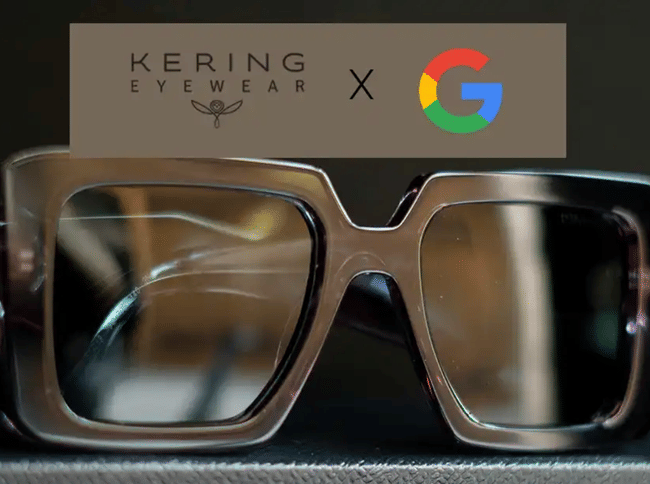
On paper, the move fits where Kering is actually making money. Group results show that while Gucci’s sales continue to fall – down roughly high single digits to low teens in Western Europe and parts of Asia – Kering Eyewear just delivered its best quarter ever, with revenue around 489 million euros and mid‑single‑digit comparable growth, and jewelry is also hitting record highs. Tying the first generation of Gucci x Google glasses to that fast‑growing eyewear division gives Kering a way to lean into a category that is structurally healthier than ready‑to‑wear, while trying to reposition Gucci as a brand that belongs in the “AI wearable” conversation, not only in fashion shows – a gamble that could either give the house a new product pillar or go down as another expensive attempt to mix tech hype with luxury heritage.
Weak quarter: Gucci pulls Kering down, Eyewear up
The smart eyewear announcement came at the same time as unpleasant numbers for the first quarter of 2026. Kering $KER.PA reported sales of 3.56-3.57 billion euros, down about 6% in reported terms and flat on a comparable basis. Gucci remains the biggest problem: sales of the flagship brand fell to around €1.34-1.35bn, down 14% on a reported basis and 8% on an organic basis - worse than the -6% expected by analysts.
Regionally, the situation varies: Western Europe fell by around 7%, Asia-Pacific by 4% and Japan by 3%, while North America managed to grow by around 9%. However, Gucci still accounts for more than 40% of group sales and around 60% of operating profit, so any decline for this brand immediately drags down the entire group.
The exception to the gloomy picture is Kering Eyewear. This division achieved record sales of around €489m in the first quarter, which means around 3% growth on a reported basis and 7% organically - in an environment where the rest of the portfolio is struggling, this is one of the few truly growing assets. It is on Eyewear that de Meo is now building part of its "ReconKering" strategy: it is not to remain an add-on, but to become a full-fledged growth pillar.
Google, Android XR and AI eyewear as the "new Ray-Ban Meta"
The $GOOGL partnership with Google isn't news out of nowhere - it follows a May 2025 agreement between Kering Eyewear and Google to develop AI glasses built on Android XR. Android XR is a new platform designed for glasses and headsets with integrated Gemini AI, focusing on spatial computing and an "in-eye assistant": a camera, microphones, speakers and an optional in-lens display for messaging, navigation, photography or real-time translation.
Google is also working in parallel with Warby Parker and Gentle Monster, with Warby Parker committing up to $150 million - half in product development, the other half as an equity investment, according to fashion media. The model is clear: Google will supply the technology platform and the underlying hardware, while brands like Gucci, Warby Parker and Gentle Monster will bring design, distribution and branding.
Kering is thus essentially copying the successful recipe of its competitors. Meta $META and EssilorLuxottica's Ray-Ban Meta glasses sold more than 7 million units in 2025, more than triple the cumulative 2 million in 2023-2024. These glasses - in a price range of roughly $299-800 - have become one of the main drivers of EssilorLuxottica's wholesale growth and have shown that a mass market for "AI glasses" exists. In addition, Bloomberg and other media outlets have reported that Meta and EssilorLuxottica are considering ramping up production to 20 million units by the end of 2026 due to demand exceeding expectations.
The luxury Gucci variants will likely aim for a higher price point than Meta's Ray-Ban, but the goal is similar in effect: to combine the everyday wearability of the glasses with the added value of an AI assistant, and to capitalize on both hardware and image and ancillary services.
It's the prototypes of Google's Android XR glasses that hint at what the underlying hardware might look like before Gucci strings its own design codes onto it.
"ReconKering": double margins and a Gucci reboot
Luca de Meo took the helm at Kering in September 2025 and at April's Capital Markets Day unveiled a "ReconKering" plan to more than double the group's recurring operating margin (roughly 11.1% in 2025) and push return on equity above 20% over the medium term.
In practice, this means a combination:
a radical overhaul of the retail sector - refurbishing or relocating two-thirds of Gucci boutiques, reducing selling space by around 20% and reducing outlets by a third
a €1 billion reduction in inventories over the next year
a stronger emphasis on the classic Gucci aesthetic codes and less on the "fads" of Alessandro Michele's hyper-creative period
For him, smart eyewear is both a symbolic and practical tool: both an extension of the Eyewear division and a way to redefine "next luxury", that is, combining high fashion with useful, human-centric technology. De Meo talks openly about the fact that the old one-size-fits-all model of global luxury no longer works, and that we can no longer rely on bags and logos alone - we need to create products that make sense in everyday life while carrying a clear brand signature.
Valuations under pressure: high P/E, falling price
Despite the technological ambitions, the market is still focused on hard numbers. According to GuruFocus, Kering has a market capitalization of around $35 billion and a consolidated P/E in the hundreds (the analysis puts it at around 460 times), reflecting the earnings slump in recent years at a still relatively robust stock price.
Following the release of the first quarter results, the stock reacted by falling around 9% to around 254 euros as investors re-priced the risk of a slow Gucci turnaround and the group's sensitivity to geopolitical tensions in Europe, Asia and the Middle East. It is Gucci - more than 40% of sales and over 60% of operating profit - that is the Achilles heel that smart glasses alone will not save, but may be a visible signal that the brand is finding its way to relevant modern luxury.
From an investor's perspective, the Gucci x Google smart glasses project is thus not an immediate solution, but part of a broader experiment: whether fashion, eyewear as a traditionally strong category and AI technology can be combined in a way that will bring not only publicity but also a tangible contribution to Kering's sales and margins over the next three to five years.