
Chinese President Xi Jinping used the summit with Donald Trump to send a clear signal to business: the "doors of China will only open more and more" and American companies, he said, are looking for "even broader prospects" in the country. He said this in front of more than a dozen heads of major US companies - including Elon Musk (Tesla), Tim Cook (Apple), Kelly Ortberg (Boeing) and Jensen Huang (Nvidia) - who are accompanying Trump on his first state visit to China in nine years.
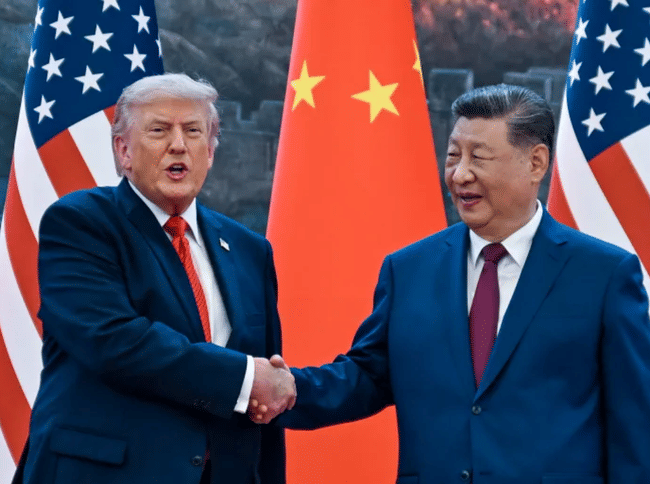
Trump vowed before his departure that his "first request" to Xi would be to "open up China to American companies," and that appeal was echoed at Thursday's meeting. Xi followed it up with rhetoric about deepening cooperation and reform and opening up that, while repeated for years, this time comes at a time when foreign investors face uncertainty over regulations, geopolitical tensions and pressure on "domestic technology."
What Xi specifically told U.S. CEOs
According to China's state-run CCTV and Xinhua news agency, Xi stressed that U.S. enterprises are "deeply involved" in China's reform and opening-up process, which has benefited both sides. "China's doors to the world will only continue to open," CCTV quoted him as saying, adding that US companies will have "even broader prospects" in China.
According to the Chinese readout, US bosses "expressed that they attach great importance to the Chinese market and want to strengthen cooperation and deepen their presence in the country". For Beijing, this wording is important - it is meant to show domestic audiences that despite the tensions, China remains key for big American brands and they themselves are interested in further growth in the country.
Above all, it is a symbolic policy of confidence: after a series of weaker macro data, a property crisis and geopolitical frictions, Beijing is trying to rebuild the narrative from "risky China" back to "opportunity for long-term investors". Xi has used similar promises of a "more open door" repeatedly - even in earlier meetings with US CEOs in 2024, he spoke of further easing market access and a 24-point plan to attract foreign capital.
Who was sitting in: Tesla, Apple, Boeing, Nvidia et al.
State TV footage showed Elon Musk (Tesla $TSLA), Tim Cook (Apple $AAPL), Kelly Ortberg (Boeing $BA) as well as Jensen Huang (Nvidia $NVDA) in the Great Hall of the People, who joined the delegation at the last minute , according to media reports. Alongside them, the wider delegation includes other players such as Micron $MU and financial houses for whom China is both a giant market and a source of regulatory risk.
Trump explicitly mentioned ahead of the meeting that the bosses "want to pay tribute to China" and are looking forward to new deals, while making no secret of his desire to take away specific deals from the summit - from agriculture and energy to a potentially historic Boeing aircraft order.
In a brief comment to reporters, Musk spoke of "a lot of good things" he wants to negotiate during the visit, Cook gave a thumbs up when asked, and Huang called Xi and Trump's talks "fantastic." Everyone knows that the symbolism is just the beginning - the real meaning will only come from the concrete regulatory steps and contracts that (in)follow.
Why Xi is talking about "more opening up" now
The rhetoric has several addressees at the same time:
US investors: China is facing outflows of some capital, pressure for delisting, and a generally worse reputation in terms of legal predictability and state intervention. Meetings with iconic CEOs and promises of further opening up are meant to restore some of the confidence.
Domestic audience: Beijing needs to show that despite Washington's tougher tone and export controls, US companies are still willing to come, sit down with Xi Jinping and talk about expansion in China.
Trump and the negotiating table: Trump has declared that his priority is to "open up the Chinese market" to U.S. companies and increase Chinese imports of U.S. agricultural, energy and industrial products. Xi's words about greater openness are partly a response to this framework - but without specific commitments on sensitive topics like technology or government subsidies.
At the same time, trade barriers and market access are a long-standing dispute dating back at least to China's WTO entry in the early 2000s. Western firms complain of asymmetric access: China benefits from open markets elsewhere but keeps many sectors under direct or indirect state control at home. Xi's "more open door" thus needs to be read against the backdrop of this structure - in many sectors, access will continue to be "on China's terms".
What "greater opening" may mean in practice
Past experience shows that similar announcements have often led to piecemeal steps, but not across-the-board relaxation:
Selective easing: Beijing may open up specific sectors or sub-segments - for example, renewing or extending licenses for imports of US beef or agricultural products, or easing restrictions on certain financial services.
More certainty for existing investments: foreign firms often call less for "more areas" to enter and more for stability and predictability in what they already have in China. The "we don't want to drive you out" signal may be as important to Tesla, Apple et al. as a brand new sector.
Deals like "more US purchases": Trump is seeking specific numbers - more imports of US agriculture, energy, machinery or aircraft. Xi's openness may manifest itself in just such packages, without fundamentally touching domestic industrial policy in high-tech segments.
Conversely, in technology (chips, cloud, data), China is likely to maintain hard red lines. The examples of Micron, Nvidia and others show that security screening and the push for domestic alternatives will continue, even if the rhetoric at the summit sounds friendly.