
The European car market has had another month of growth. According to April data from ACEA, new passenger car registrations in the EU rose 5.1% year-on-year to 972,314 vehicles. The driver is not internal combustion engines but electrification, with sales of battery electric vehicles jumping by almost 38%, a rate several times faster than the growth of the overall market. Electric mobility is no longer a fringe segment but one of the main drivers of demand in Europe.
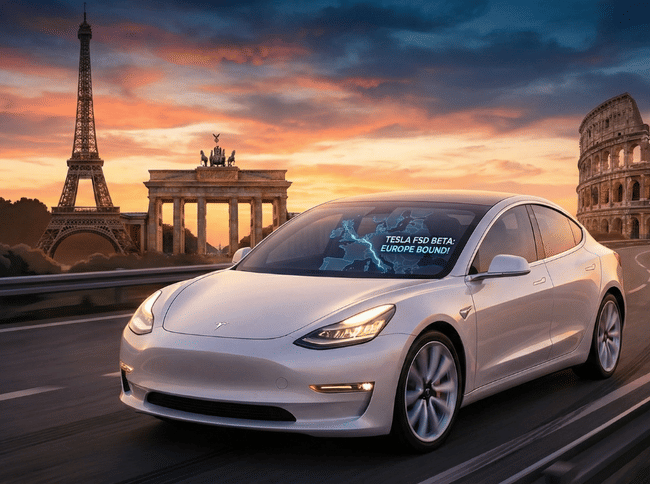
At the same time, the battle for the "throne" in European EVs is proving to be much fiercer than it might have seemed a few years ago. Tesla is regaining traction in the region after a weak period, but Chinese brands are stepping on the gas even faster. Meanwhile, European brands are facing dual pressures - regulations and emissions targets on the one hand, and an aggressive price and product offensive from China on the other.
April in Europe: battery cars drive market growth
April's figures clearly show that sales growth in the EU is now driven by pure electric cars. While the overall market added just over 5%, battery electric vehicles (BEVs) jumped by almost 37-38%. In other words: while overall registrations are growing slowly, the BEV segment is expanding at several times the rate and stealing an increasing share of the market.
In the first four months of 2026, new car registrations in the European Union increased by 4.2%, with the share of battery electric vehicles rising to around 19.7% compared to around 15.3% in the same period last year. This is not a cosmetic shift, but a structural change - almost one in five newly registered cars in the EU is already pure electric.
Tesla $TSLA: From European downturn to visible recovery
Even at the beginning of the year, Tesla seemed to be losing its breath in Europe. Competitive offerings had expanded, the EV price war was squeezing margins, and Chinese brands began flooding the market with cheaper models. But April signalled a turnaround.
Tesla's registrations in the EU jumped 67.2% year-on-year to 9,169 cars. Market share rose from around 0.6% to 0.9%. At first glance, this may seem like a small number, but in the context of a short monthly timeframe, it's a strong signal that Tesla is breathing again after a prolonged lull in the European market. In aggregate for the period January to April, Tesla increased its registrations in the EU by 61.7%, underlining that this is not just a one-off blip.
There are several reasons. Tesla has a history of aggressive pricing adjustments to bring its models closer to a wider audience in Europe. At the same time, it benefits from a still-strong brand and an extensive Supercharger network that remains a competitive advantage in the perception of ordinary customers. Yet it is clear that in Europe Tesla is no longer a clear synonym for the electric car, but one of the more significant players.
The Chinese offensive: BYD, Chery and MG take a bigger slice of the pie
While Tesla is growing again in Europe, the momentum of Chinese brands is even more pronounced. BYD more than doubled its car registrations in the EU in April. Chery, which is still less well known in Europe than BYD $BY6.F, managed to almost quadruple registrations year-on-year. And SAIC, which operates in the European market mainly through its reborn MG brand, reported growth of around a quarter for April.
For the first four months of 2026, the numbers look even more convincing. Tesla may have added about 61.7%, but BYD shot up about 153% in the same period. This means that while Tesla is still nominally selling more in Europe, the pace of growth and gradual erosion of market share is now primarily driven by Chinese players.
This development comes despite growing trade frictions between the EU and China. Brussels is considering tariffs and restrictions on imports of Chinese electric vehicles in response to massive state support for domestic manufacturers in China. But so far this has not prevented Chinese brands from growing rapidly. If the EU does indeed move to more significant tariff barriers, this could slow expansion in the short term, but in the long term Chinese manufacturers are likely to seek to locate some production directly in Europe.
Who really "rules" the European EV market today
The question of who rules the European EV market has no simple answer. In terms of absolute number of vehicles sold and penetration in Western European markets, Tesla still holds a strong position, along with European brands such as Volkswagen $VWAGY, Stellantis $STLA or Mercedes $MBG.DE. But if we look at growth dynamics, rate of share gain and pricing pressure, it is the Chinese brands led by BYD and MG that come out as the most aggressive players today.
So the reality is that the European throne is not firmly in the hands of one manufacturer. Tesla is rising again and showing that it is not a write-off. Meanwhile, Chinese companies are using a combination of scale production, lower costs and aggressive pricing to get the biggest piece of the pie. European carmakers stand in the middle: they have strong brands and a local presence, but must manage the transition to electric mobility without losing margins and market share.
For an investor, it is crucial to distinguish between two levels:
who is selling the most today
and who is growing the fastest and has the best chance of being king tomorrow.
In the first case, Tesla and traditional European manufacturers still have a significant role to play. In the latter, however, the Chinese players stand out the most and could fundamentally redraw the map of the European EV market within a few years.
The implications for investors
Fresh data shows that the European EV market has moved from an early growth phase to a fiercely competitive one.
Tesla is showing that it can resume growth after a period of weakness even in a challenging environment, but it no longer has a monopoly on the perception of the "modern" EV.
Chinese brands are proving that their expansion is not just a marketing story, but backed up by real growth in registrations and an increasing presence on European roads.
European carmakers will have to innovate faster, streamline production and adapt to the price levels set by Chinese competition - otherwise they may gradually lose share in their home region.