Thoughts?
This is a pie where I regularly add some extra Czech crowns.
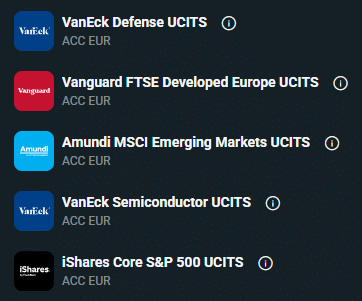
Allocation:
Defense 5%
FTSE Developed Europe 10%
MSCI Emerging Markets 10%
Semiconductors 10%
S&P 500 65%

This user has access to exclusive content, tools and features of the Bulios platform thanks to their subscription.
Thoughts?
This is a pie where I regularly add some extra Czech crowns.
Allocation:
Defense 5%
FTSE Developed Europe 10%
MSCI Emerging Markets 10%
Semiconductors 10%
S&P 500 65%
Doesn't VWCE have an almost identical composition?
In the S&P 500 there’s almost 20% semiconductors, in EM even more — TSMC alone has over 15%. So when you add it up: 10% Semi ETF + ~12% from the S&P 500 + ~3% from EM + a bit from Europe = you actually have roughly a quarter of the portfolio wagered on semiconductors. That’s quite a lot (although from what I’ve seen, there are even bigger hitters in this group).
Otherwise, personally I would consider, instead of the combination S&P 500 65% + FTSE Developed Europe 10%, using a single broad ETF like SWDA / MSCI World. It’s not exactly the same exposure, but as a portfolio core it’s a cleaner and simpler solution.
And one more question: why are you buying USD/global indexes via EUR listings? “ACC EUR” doesn’t automatically mean hedged to the euro. Do you have income in euros? The EUR variant of an ETF can have worse liquidity and a wider spread.
Let's go, I really enjoy portfolio breakdowns, so let's do this!
At first glance, this is a fairly sensibly constructed growth portfolio with a strong tilt toward the U.S. market. $^GSPC The S&P 500 forms the foundation here and is the main source of returns, which makes sense over a long investment horizon.
It's worth noting, however, that the actual U.S. exposure is in fact higher than the stated 65%. A significant part of the semiconductor sector consists of American companies, and there is similar overlap in the defense industry. The portfolio is therefore heavily tied to the U.S. economy and, above all, to developments in the tech sector.
I like the inclusion of Europe and emerging markets, which at least somewhat improve geographic diversification. On the other hand, I would consider whether Semiconductor and Defense truly add new diversification or merely increase exposure to positions that are already in the S&P 500.
If the goal is long-term investing and "wealth building" and you're consciously betting on the continued dominance of the U.S., then the portfolio makes sense to me. Just be aware that it's not a broadly diversified global portfolio.