
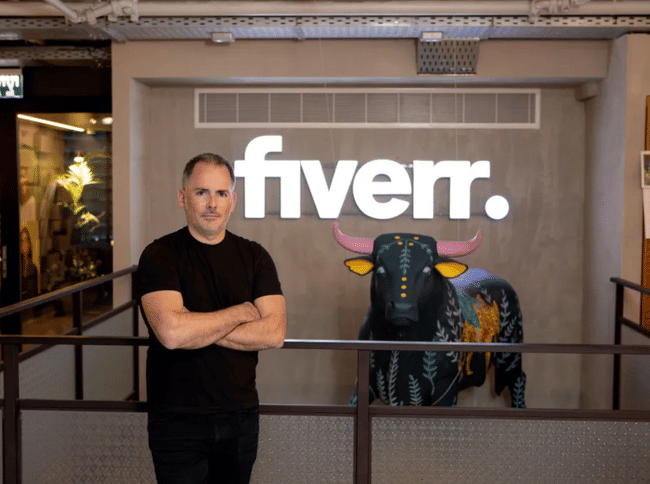
The freelance platform Fiverr reports a revenue drop of more than a billion, and its stock is hovering near historic lows. What’s behind this, and why do some analysts still believe in a turnaround?
Numbers That Hurt
There was a time when Fiverr looked like a star. The pandemic era sent $FVRR stock soaring to over $230, companies were buying freelance services online in droves, and the platform was racking up praise for its growing ecosystem. Today, the situation is different.
The stock is trading around $10— that’s roughly 95% below its all-time high. And the results for 2025, along with the outlook for this year, suggest that the bottom may not yet be behind us.
For the full year 2025, revenue reached $430.9 million, up roughly 10% year-over-year. But this year is expected to be significantly worse. In April 2026, Fiverr’s management issued guidance for the full year 2026 of $380 million to $420 million—which would represent a year-over-year decline of 3% to 12%. For a platform that was recently talking about expansion, this is a painful admission.
The current quarter brought in $105.5 million in revenue, slightly below the level of the same quarter last year. There are still 2.9 million active buyers —the user base isn’t growing, but average spending per customer has risen to $356 per year.
What’s Actually Changing
Fiverr is trying to rebuild its business model. The original platform functioned as a marketplace for small digital tasks at fixed prices—a logo for $5, text editing for $10. But AI has increasingly been taking over this market segment.
Management is therefore betting on higher-value services. The number of clients spending over $1,000 on a single project on the platform grew by 18% year-over-year. The “Services revenue” segment—that is, direct services managed by the platform, not just brokerage— reached $38.4 million in Q1 2026, a 30% year-over-year increase. This segment accounts for roughly 36% of total revenue and is currently the fastest-growing part of the business.
However, the restructuring of this large organization is ongoing. CEO Micha Kaufman himself described 2026 as a transitional year —one of investment, with no guarantee of immediate results. Management expects to see more significant effects from the transformation in the second half of the year at the earliest, and in 2027.
"We are seeing the first signs that our investments in high-value projects and platform capabilities are beginning to pay off."
Micha Kaufman, CEO of Fiverr
Margins hold steady, analysts lower targets
Despite the decline in revenue, Fiverr has so far managed to maintain profitability. Adjusted EBITDA in Q1 2026 reached $22.6 million, with the margin rising to 21% —an improvement of more than 3 percentage points year-over-year. The company generates free cash flow of around $21 million per quarter and has an approved share buyback program for an additional $59.5 million.
The problem, however, is that margins could decline over the course of the year. Guidance for Q2 2026 anticipates revenue of $95 million to $103 million and EBITDA margins of around 18%—significantly below the Q1 level. The year 2026 as a whole is expected to yield an average margin of around 18%, as the company increases investments in platform restructuring.
Analysts reacted to this with caution. In February 2026, BTIG lowered its price target from $31 to $18 but maintained its “Buy” rating. The market consensus is significantly more cautious today than in last year’s briefing—the “Hold” rating prevails.
"Fiverr remains in a transitional year, where growing momentum in high-value deals has yet to offset challenges on the core platform."
TipRanks, Analyst Summary, April 2026
Two Faces of One Platform
The paradox of Fiverr lies in the fact that the company looks different across two distinct metrics.
On one hand: declining total revenue, stagnating buyer numbers, and a stock drop of tens of percent over the past 12 months. Strong competition from Upwork, but also growing pressure from AI tools that are taking over routine tasks—which previously formed the basis of Fiverr’s traditional catalog.
On the other hand: improving margins, rising spending by premium customers, solid cash flow, and a meaningful strategy focused on more complex projects. Fiverr Pro—a curated tier of verified freelancers—is showing its first concrete results: tests of the new matching system have reduced the mismatch rate between clients and freelancers by nearly 10%.
What the numbers say today
Current snapshot as of June 2026:
Stock price: $10 (52-week range: $9.67 - $33.96)
Market capitalization: $350 million
FY 2025 revenue: $430.9 million (+10.1% year-over-year)
FY 2026 guidance: $380–420 million (3–12% decline)
Q1 2026 EBITDA margin: 21%
Q1 2026 services revenue: $38.4 million
Spend per buyer: $356
Fiverr is currently a story of ongoing restructuring in a challenging environment. The transformation may succeed—but 2026 will likely be worse before things get better in 2027. This is a call for patience, not for quick profits.