
The golden arches are a symbol of fast food, but for dividend investors, they mean something else—half a century of continuous dividend increases. And the stock is now trading at its annual low.
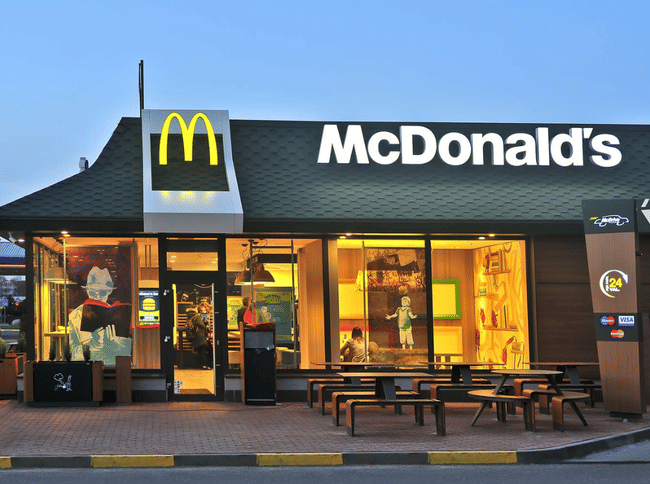
There are approximately 1,400 companies listed on U.S. stock exchanges that regularly pay dividends. Fewer than seventy of them have increased their dividends every year for at least 25 years—and they bear the honorary title of “Dividend Aristocrat.” Only forty companies worldwide have managed to do so for fifty consecutive years.
McDonald’s $MCD has just joined this exclusive club known as the Dividend King.
The numbers speak for themselves
The quarterly dividend currently stands at $1.86 per share, or $7.44 per year. At today’s share price of around $272, this corresponds to a yield of approximately 2.7%.
Anyone who held McDonald’s stock ten years ago was receiving a significantly lower dividend. According to Digrin data, the average annual dividend growth over the past three years has been approximately 8.8%. In other words, the dividend doubles every eight years. For investors who hold the stock for the long term, the effective return on the original purchase price thus increases year after year.
Key figures today:
Annual dividend: $7.44 per share
Yield: 2.7% (at a price of $272)
Number of consecutive annual increases: 50
Average dividend growth over 3 years: 8.8%
Market capitalization: $193 billion
Why the Golden Arches Won’t Run Dry
McDonald’s isn’t just a restaurant chain. It’s a real estate and franchise machine that generates stable cash flow regardless of how consumers are faring.
Over 95% of its more than 40 ,000 locations are operated by independent franchisees. McDonald’s owns or leases the land, collects fees and royalties—and shifts operational risk to the franchisees. The result is a business with operating margins hovering around 46%, a level that many tech companies would envy.
The full-year 2025 results confirm this model in practice: global revenue for the entire system rose to $139 billion, comparable sales for 2025 increased by 3.1% year-over-year, and net income reached $8.56 billion, up 4.1% year-over-year. It is precisely the stability of these figures that guarantees shareholders will receive a dividend in the next quarter as well.
"McDonald's is one of the few companies where you can be relatively certain that the dividend will continue to grow in five, ten, and fifteen years—and that is a rare quality for income investors."
Dividend Strategy Analyst, Sure Dividend
Stock at a Yearly Low—Opportunity or Trap?
This is where things get complicated. MCD stock is trading near its 52-week low in June 2026—on June 23, it ranged between $270 and $274, while the 52-week high was $341.75. That’s a decline of roughly 20% from the peak.
McDonald’s suffered from a decline in foot traffic in the first half of 2025 —in the first quarter of 2025, comparable sales in the U.S. fell by 3.6%, with customers in the lower and middle income brackets feeling the impact the most. This was compounded by adverse currency effects and restructuring costs.
Since then, however, the situation has turned around. In the first quarter of 2026, global comparable sales rose by 3.8%, with a 3.9% increase in the U.S. and a 3.9% increase in international markets. The company also reaffirmed its full-year financial targets.
The average consensus among 34 analysts is a price target of $331 —which would represent more than 20% upside potential from current levels. Of course, no price target is a guarantee.
"Consumers today face uncertainty, but they can always count on McDonald’s—for consistent value that helps them stretch their family budget."
Chris Kempczinski, CEO of McDonald’s, Q1 2026 earnings call
McDonald’s > NEXT: A Bet on the Next Five Years
Just as its stock is losing ground, McDonald’s has unveiled a new strategic plan. At the June franchisee conference in Las Vegas, CEO Kempczinski unveiled an initiative called McDonald’s > NEXT — the first comprehensive global strategy since 2020, when the “Accelerating the Arches” plan was launched.
The plan is built on four pillars: a new restaurant design, better-tasting food and beverages, customer-driven innovation, and enhanced hospitality. Specific financial targets are set to be announced at the investor day in September 2026.
In terms of numbers, this currently translates to an ambition to reach 50,000 restaurants by the end of 2027 —approximately 10,000 more than today. China is the key market for expansion. In addition to physical expansion, McDonald’s is investing in order automation, currently testing the ARCHY system—designed for automated order processing—at five U.S. locations.
It is interesting to note the focus on chicken and beverages as the categories with the greatest potential. In the chicken segment, McDonald’s has long been losing customers to specialty chains—a fact acknowledged by Kempczinski himself, who noted in an internal memo that “traditional competitors are refining their menus, and a new wave of specialists is redefining quality in the areas of chicken, beef, and beverages.”
Half a century is a strong argument
McDonald’s is not a stock for speculators. It’s a story of compound interest applied to dividends —the sooner you start reinvesting your dividend payments back into the stock, the more significant the effect will be in twenty years.
Current valuation— a P/E ratio around 22, a yield over 2.7%, and the stock at its annual low—looks reasonable on paper. Risks include pressure on consumers amid high prices, growing competition, and higher expansion costs. Financial details of the new NEXT strategy are still lacking.
But the basic equation is simple: 50 years of continuous dividend growth doesn’t happen by accident. It results from a combination of a recession-resistant franchise model, management discipline, and tangible assets in the form of real estate scattered across the globe. That is value that won’t expire—no matter what people eat over the next fifty years.