
Nvidia poured $2 billion into the company, Uber partnered with its robotaxi division, and the stock price went through the roof. But analysts’ average price target is below the current price. Is this a story, or an overheated bet?
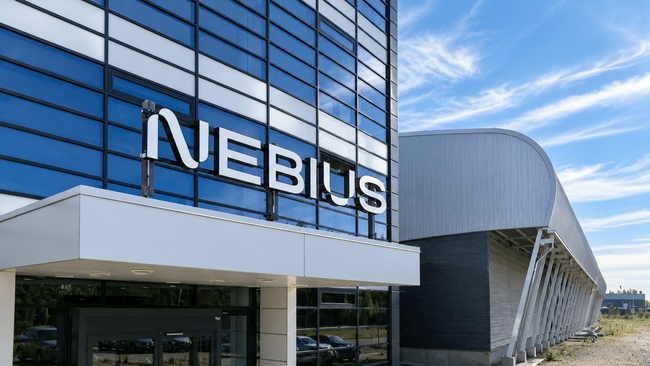
When Nvidia $NVDA invests in a company, the market takes notice. And when it also adds that company to its Nasdaq-100 index and Uber $UBER partners with it, it creates exactly the kind of story that retail investors go crazy for. We’re talking about the Dutch company Nebius Group $NBIS, a stock that has surged by hundreds of percent over the past year and has become one of the most closely watched names in the entire AI boom.
But behind all that excitement lies an unpleasant detail. While the price is breaking records, most Wall Street analysts expect the stock to fall. Let’s take a look at what Nebius actually does and why opinions on it differ so dramatically.
From the Ruins of Yandex to One of the Hottest AI Names
Nebius has one of the most unusual origins on the U.S. stock market. The company emerged from the breakup of Russian tech giant Yandex, which was forced to sell off its Russian assets following sanctions in 2022. What remained moved to Amsterdam, shed its geopolitical baggage, and transitioned into the role of a pure-play AI cloud provider.
Today, Nebius is building what’s known as “neocloud” infrastructure—data centers packed with graphics chips that companies use to train and run artificial intelligence. It’s the same business model as CoreWeave $CRWV, for example, and demand for it is exploding.
The numbers illustrate this starkly. A year ago, Nebius reported quarterly revenue of around $50 million. In the first quarter of 2026, that figure was $399 million, according to the company’s filings with the U.S. SEC. That represents year-over-year growth of around 680%, which is unprecedented in the sector.
"This isn’t a one-off spike. Demand for AI computing power is growing faster than most analysts’ models can keep up with."
An analyst tracking the non-cloud sector
Nvidia, Uber, and the Bet on “Full-Stack” AI
A key moment came in March, when Nvidia announced a direct investment of $2 billion (roughly 42 billion crowns) in Nebius. It’s not just about capital. Part of the agreement is a plan to deploy over 5 gigawatts of Nvidia computing systems by 2030—which, according to a Bloomberg report, is enough energy to power roughly 3.8 million households.
It’s important to understand the motivation here. Nvidia isn’t just selling chips to Nebius—it’s putting its own money into the company. When the world’s most valuable company risks capital alongside its customer, the market interprets this as a stamp of confidence. Moreover, Nvidia has made similar investments in other suppliers, so this is part of a broader strategy to kickstart the entire AI ecosystem.
The other side of the story is perhaps even more interesting. Nebius owns the Avride division, which develops autonomous vehicles and delivery robots. And it is Avride that has entered into a partnership with Uber, with both companies investing up to $375 million. Avride’s robots are already delivering food via Uber Eats in U.S. cities like Austin and Dallas, and a robotaxi service is set to launch on the Uber platform.
Taken together, this paints a picture of a company that aims to cover the entire artificial intelligence value chain: from data centers through the cloud to physical robots on the street. This is called a “full-stack” approach, and to investors, it sounds like a dream.
D-Day: Entry into the Nasdaq-100
Today’s date is no coincidence. On June 22, Nebius officially joins the prestigious Nasdaq-100 index, alongside other AI players including CoreWeave and Rocket Lab. For the company, this means an automatic influx of money from index funds, which are required to buy the stock, and, most importantly, greater prestige in the eyes of institutional investors.
And that’s not all. In recent weeks alone, Nebius has racked up a string of positive news:
Inclusion in the Nasdaq-100 (June 22) and the resulting mandatory purchases by index funds.
The completed acquisition of Eigen AI, a company focused on optimizing AI models, which is expected to strengthen its cloud platform.
Expansion in the United Kingdom for approximately 1.7 billion pounds, including the construction of new data centers.
In short, one piece of good news after another. No wonder the stock price is soaring.
When a stock gains +500% in a year
The stock is currently trading around $286 and has gained over 500% in the last twelve months. Market capitalization has climbed to roughly $72 billion, which is about 1.5 trillion Czech korunas. For a company that was, until recently, an insignificant remnant of Russia’s Yandex, this is a staggering leap.
The catch that isn’t talked about much
But here’s where the story starts to unravel. Although everything looks rosy, analysts’ average 12-month price target hovers around $244, as shown by data from stockanalysis.com. In other words, the Wall Street consensus expects the stock to fall from today’s level—by more than ten percent.
There are several reasons for caution:
Insane capital intensity. Nebius plans to invest (capex) $20 to $25 billion in 2026. That’s more than the company earns, and the whole plan hinges on its ability to build data centers on time, secure power for them, and fill them with orders.
Profit quality. Analysts point to a high proportion of non-cash items in the financial statements, which makes it difficult to gauge true profitability, especially as the company simultaneously raises capital and issues convertible bonds.
Competition from the giants. Amazon $AMZN, Microsoft $MSFT, and Alphabet $GOOGL also operate the same business—renting out computing power for AI—through their cloud services (AWS, Azure, Google Cloud). Nebius is competing with them for the same customers, but against companies with incomparably deeper pockets that also build their own chips.
And then there’s the simple question of valuation. With a price-to-earnings (P/E) ratio of around 105, Nebius is trading at levels that assume absolutely flawless execution of its future plans. Any hiccup—whether a construction delay, a permitting issue, or a robotaxi accident—could send the stock price tumbling. It’s no coincidence that firms like DA Davidson, Wolfe Research, and Seaport Research have initiated coverage of the stock with only a neutral rating, even though they view the business itself positively.
“The business is real, and the growth is real. But the re-rating from a purely speculative non-cloud stock to an institutional infrastructure stock has already largely taken place.”
Summary of the views of analysts at DA Davidson, Wolfe Research, and Seaport Research
What It’s All About
At its core, Nebius is a bet that the demand for computing power for artificial intelligence isn’t going away anytime soon, and that a small player from Amsterdam can carve out a decent slice of the pie even against the hyperscalers. Investments from Nvidia, a partnership with Uber, and its inclusion in the Nasdaq-100 all reinforce this thesis.
At the same time, however, the company is burning through a massive amount of capital, and its valuation leaves no room for error. Interestingly, just as euphoria reaches its peak—with the stock entering the elite index—the analyst consensus is cautiously standing on the sidelines. Neobius has thus become the perfect test case for the question the entire market is asking today: where does justified enthusiasm for AI end, and where does madness begin?