
Big tech companies can sell big stories, but the real bottleneck in advanced chips is often simple: how many wafers a lithography tool can process in an hour. ASML says it has made a technical step forward in the light source used in its most important machines. The goal is clear. By the end of the decade, customers should be able to produce up to 50% more chips with the same EUV tool time.
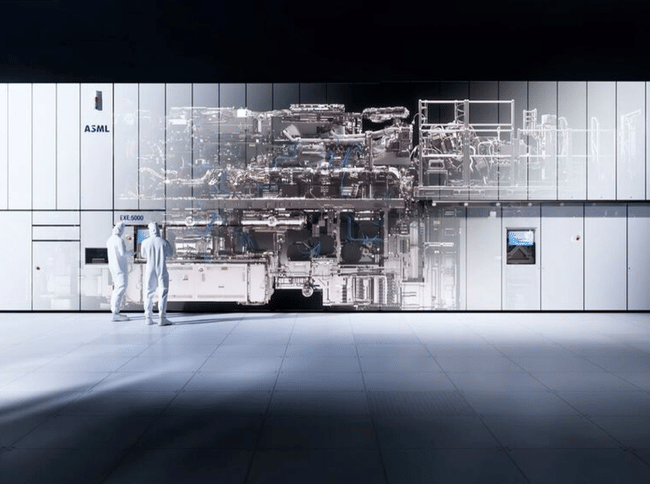
For investors, the key point is that ASML is not describing a lab demo. The company says the system can deliver 1,000 watts of EUV light power under conditions that match real customer use. If that holds in the field, it can lower the cost per chip at the most advanced nodes. It also helps ASML defend its lead at a moment when new competitors in the US are trying to catch up and China is pushing hard to build its own capabilities.
What ASML actually announced: 1,000 W instead of 500-600 W
The crux of the news is simple and hard to measure: ASML researchers have raised the EUV power of the light source to 1,000 watts from roughly 600 watts today. In lithography, this is not a detail - higher power means shorter "illumination" time on the wafer, i.e. faster production rates with the same quality requirements.
Meanwhile, ASML is still the only company in the world that supplies commercial extreme ultraviolet lithography (EUV) machines - a technology that the most advanced computing chips from companies like TSMC $TSM or Intel $INTC cannot do without.
Why source performance matters: speed, cost and factory capacity
In practice, the economics of all semiconductor manufacturing are at stake. When one key step (illumination) is made faster, the number of wafers a machine can handle per hour goes up. ASML directly mentions the target that customers should get to about 330 wafers per hour by the end of the decade, compared to about 220 wafers per hour today.
This then translates into the price of each chip: the same factory can produce more, and with no need to add as many expensive machines, the unit cost goes down. For advanced processes, where the investment in equipment is extreme, such a change is one of the few levers that can move costs down visibly.
How it technically works: tin, laser and "plasma"
ASML $ASML produces EUV light in a way that is itself technologically frontier. Tiny droplets of molten tin are fired in a chamber, which are then hit by a powerful laser, turning the tin into an extremely hot state (plasma) and emitting EUV light with a wavelength of 13.5 nanometers in the process. This is then collected through high-tech optics and fed into a machine where it "draws" structures onto the wafer.
The specific shift to 1,000 watts is to be based on two changes: ASML has increased the number of tin droplets to about 100,000 per second, and instead of one "shaping" laser pulse, it uses two smaller pulses to better prepare the material for the main hit. The result is higher stable power and a path to further scaling.
Why it's news for the competition, too: The US and China are pushing for the emergence of alternatives
EUV machines are so strategic that there has been a geopolitical battle around them for years. The U.S. has long pressured the Netherlands not to ship the most advanced systems to China - and China has simultaneously invested massively in domestic attempts to build an alternative.
What's new is that alongside Chinese ambitions, a US effort to create competition directly at a critical part of the system - the EUV light source - is beginning to take shape. Reuters mentions at least two startups working on this that have raised hundreds of millions of dollars. At the same time, direct government support is also visible: xLight, for example, has announced a "letter of intent" type agreement with the US Department of Commerce for up to $150 million in support to develop an alternative approach to the EUV source.
ASML's message with this shift is simple: even if someone once builds a competitive "foundation", ASML wants to be several iterations ahead. And the company itself says it already sees a realistic path to 1 ,500 watts and beyond in principle, in addition to 1,000 watts.
What this may mean for ASML's results: demand, pricing and the investment cycle
In the short term, there is no immediate jump in sales from this. Rather, it is a strengthening of the "product roadmap" and an argument for customers to plan EUV capacity going forward. In the ASML business, several effects play a role at once: when throughput (wafers per hour) goes up, customers can get some of the capacity "cheaper" on the same basis, but it also makes EUV even more attractive for a wider range of production - and that can support long-term demand for additional systems and upgrades.
Context is also important: China has in recent months been trying to increase performance even on older machines, as EUV technology is virtually unavailable to it due to constraints. This shows two things - how huge the motivation to catch up with the top is, and also how strong ASML's position is at the most advanced nodes.
What to watch next: 3 specific signals
First, when and in what form ASML will start to take the 1,000-watt resource from internal demonstration to real installations, and how it will talk about stability and availability of power "at the customer".
Second, whether expectations around EUV system throughput (target of 330 wafers per hour) will start to change in the specific production plans of the big foundry players.
Third, how quickly the US pursuit of alternatives (xLight and others) will move and whether additional public funding or partnerships with large players will be added.